
Ленорман Ръководство
Lenormand Card Combinations — How to Read Them Together
Аудио версията не се поддържа от вашия браузър.
Theory is for everyone. Your chart is only yours — see what 2026 holds for it.
My yearly report →In short:
If you're coming from the world of Tarot, the first thing you need to forget is the deep analysis of a single card. To understand Lenormand vs. Tarot — what's the difference, you must realize that Lenormand is a literal, direct, and practical system. There are no archetypes here, no hidden spiritual messages, and secret mysteries. There are concrete events, people, and situations.
In Lenormand, a card is simply a word. Imagine someone tells you the word "House." What about the house? Are you buying it? Selling it? Renovating it? Is it on fire? Is someone coming into it? By itself, a card provides no answer. It needs a second card to complete the thought. This is where the mastery lies — in seeing how Lenormand cards together form clear, unambiguous messages.
As you begin to study the meanings of the 36 Lenormand cards, you'll quickly notice that each has a solid core of keywords. Fish are money. The Fox is work or deception. The Heart is love. When you combine them, you are literally translating symbols into human language. This translation process requires adherence to a few basic grammatical rules that make the system so accurate.
The most important principle when learning how to read Lenormand cards is the noun and adjective method. In a pair of cards read from left to right, the first card typically plays the role of the noun (the focus, the theme), and the second card is the adjective (the description, the modifier).
Let's examine this mechanism with a specific example. We take the Rider card (news, message, someone is coming) and the Clover card (luck, small joy, brevity).
Although the two combinations are similar, the nuance is different. In the first case, you are waiting for an email that will make you happy. In the second case, you have sudden luck, the result of which is some message or action. The order determines the focus.
Another classic example: House (home, family, security) and Tree (health, growth, roots, boredom).
This simple grammatical approach is the backbone of any reading. When you do a free Lenormand reading or lay out the cards at home, always ask yourself: What is the base theme, and which card modifies it?
In Lenormand, there are clearly defined negative cards. Unlike other systems where everything can be interpreted as a "spiritual lesson," here negative cards bring real problems — losses, illnesses, betrayals, obstacles. When a negative card stands next to a positive one, it drastically alters it.
The most common negative cards are Clouds (confusion), Snake (betrayal, complications), Coffin (end, stagnation), Scythe (sudden cut, danger), Whips/Broom (conflict), Mice (loss, stress), Mountain (obstacle, blockage), and Cross (burden, suffering).
Here's how they change the cards around them in various Lenormand combinations:
The Scythe is fast, sharp, and often painful. It cuts what it touches. The direction of the blade (if your deck has a clearly drawn blade) also matters, but even without it, the rule of order applies.
While the Scythe cuts sharply, the Mice gnaw slowly. They bring stress, theft, draining of energy or resources. The Mice diminish the value of the card next to them.
The Coffin does not mean physical death in 99% of cases. It is the drawer that closes. Stagnation, the end of a cycle, emptiness.
The Mountain is a wall. It slows things down, makes them difficult, and requires effort.
The biggest mistake beginners make is looking for fixed Lenormand combination meanings in tables and applying them blindly. Two cards can mean ten different things depending on the question. Context filters the meanings.
Let's take the combination Ring (contract, relationship, cycle) + Ship (travel, abroad, trade).
If the question is: "What will happen in my love life?"
The answer is: A long-distance relationship. The partner's departure. Honeymoon.
If the question is: "Will I sign this business contract?"
The answer is: Yes, the contract will be signed and is related to international trade, import/export, or a foreign company.
If the question is: "Why is my car making a strange noise?"
The answer is: A problem with the wheels, the belts (Ring - something round) of the vehicle (Ship - transport).
Without a clear question, the cards are just pictures. Before you draw even one card, you need to know exactly what you are asking. If you want to learn more about asking questions correctly and spreads, check out Lenormand Cards — A Complete Beginner's Guide.
To build intuition for the language of the cards, it's helpful to see how the main cards connect in different life areas. Below are some of the most common and useful combinations.
| Combination | Meaning in a Love Context |
|---|---|
| Heart + Ring | Strong, committed love. Marriage proposal. Long-lasting emotional connection. |
| Heart + Dog | Love based on deep friendship. Loyalty in feelings. A partner you can rely on. |
| Heart + Cross | Karmic love that carries a burden. Painful feelings. Love that requires sacrifice. |
| Heart + Snake | Jealousy, infidelity, toxic feelings. Strong sexual attraction, but with an element of deception. |
| Ring + Paths | A decision regarding the relationship. An open relationship. Multiple partners or a choice between two people. |
| Ring + Tower | An official union (legal marriage). But it can also mean isolation in the relationship, distance between partners. |
In Lenormand, the Anchor traditionally symbolizes long-term work and stability, while the Fox represents the daily nine-to-five job, skills, but also workplace cunning.
| Combination | Meaning in a Professional Context |
|---|---|
| Anchor + Fish | Stable job with excellent income. Well-paid profession. Financial security. |
| Anchor + Ship | Work in tourism, transport, or logistics. Working with foreign clients. |
| Fox + Bear | A smart and influential boss. Need for strategic thinking to deal with management. Financial advisor. |
| Fox + Letter | Employment contract. Work documents. But also: watch out for the fine print, there might be a catch (Fox). |
| Anchor + Clouds | Job insecurity. Unclear responsibilities. Fear of layoff or instability. |
| Anchor + Scythe | Sudden resignation or dismissal. A sharp change in professional status. |
Fish symbolize the flow of money, liquidity, and trade. The Bear represents large sums of money, investments, banks, and personal savings.
| Combination | Meaning in a Financial Context |
|---|---|
| Fish + Key | Certain financial success. Resolution of a financial problem. Successful investment. |
| Fish + Tree | Money that grows slowly but surely. Long-term investment (e.g., pension fund). |
| Fish + Mice | Loss of money. Hidden fees. Expenses that deplete the budget. Financial stress. |
| Bear + Tower | Bank, tax institution, corporate finance. Large financial organization. |
| Bear + Letter | Check, bank statement, invoice for a large sum. Financial documents. |
| Fish + Whips (Broom) | Disputes over money. Salary negotiations. Financial conflicts in the family or business. |
News in Lenormand comes in various forms. The Rider is fast, usually direct news. The Letter is a written document, email, or message. The Birds are gossip, phone calls, social media, and verbal communication.
| Combination | Meaning in the Context of Information |
|---|---|
| Rider + Bouquet | Good news that brings joy. Invitation to an event. Pleasant surprise. |
| Letter + Key | A very important message. The document that solves the problem. Password or important code. |
| Birds + Snake | Malicious gossip. Lies about you. Toxic conversations behind your back. |
| Rider + House | News about the family. A guest arriving at your home. A message related to property. |
| Letter + Clouds | Confusing message. An email that creates ambiguity. A document with errors. |
After mastering the reading of two cards, the next step in how to read Lenormand cards — step-by-step spreads is moving on to three cards. The trio (or triad) is perhaps the most popular and flexible way to get quick answers.
When you have three cards (Card 1 + Card 2 + Card 3), there are several ways to read them together.
You read them from left to right like a sentence. Card 1 is the beginning/situation, Card 2 is the action/development, Card 3 is the outcome.
Example: Clouds + Letter + Sun.
There is confusion and ambiguity (Clouds). You receive a document or email (Letter). This brings complete clarity and a successful outcome (Sun). Answer: The situation will be clarified successfully through a written message.
The middle card (Card 2) is the core of the issue. Card 1 and Card 3 are its modifiers (adjectives).
Example: Paths + Heart + Anchor.
The focus is the Heart (love). On one side, we have Paths (choice, hesitation), on the other, Anchor (stability). Answer: You are facing a choice in love, but your decision will lead to long-term stability.
This is a technique where the first and last cards are read together to provide the hidden meaning or ultimate goal of the spread. In a three-card spread, Card 1 "mirrors" Card 3.
Example: Mice + Book + Key.
The center is the Book (secret, learning, something hidden). Linearly: Stress (Mice) about something hidden (Book), which is ultimately revealed successfully (Key). Mirrored: Mice + Key = Resolving the problem of stress/loss. The secret you will learn will stop your worries.
In Lenormand, the Man (28) and Woman (29) cards are significators. They represent the querent or a specific person in their life. By themselves, they have no meaning — they are completely neutral. Their meaning comes ENTIRELY from which Lenormand cards together they appear with.
If you draw Man + Dog, it describes the man as friendly, loyal, perhaps someone you've known for a long time. If you draw Man + Snake, it's a man who is a deceiver, a manipulator, or simply very intelligent and flexible (depending on the context).
In larger spreads, the cards that fall immediately around the significator show what is on his mind (cards above), what he controls (cards below), what he is leaving in the past (behind him), and what lies ahead for him (in front of him). To understand this complex dynamic, it is recommended to familiarize yourself with the Grand Tableau in Lenormand, where all 36 cards participate in creating a massive network of combinations.
Even experienced readers of other systems often stumble with Lenormand due to its specificity. Here's what to avoid when forming Lenormand combinations:
The best way to learn the language of Lenormand is through daily practice. Here's a simple exercise:
Every morning, draw two cards. Don't ask a heavy, fateful question. Simply ask: "What will be the focus of my day?"
If you draw Letter + Birds, you might spend the day answering emails and making phone calls. If you draw Anchor + Bouquet, you will have a very pleasant and calm workday. In the evening, look at the cards again and analyze how they manifested.
Don't try to memorize thousands of possible combinations. Instead, understand the essence of each card and use logic to combine them. The cards are the alphabet. The combinations are the words. You are the storyteller.
No. In traditional Lenormand, cards are not read reversed (upside down). The negative or positive meaning is determined entirely by the cards that stand next to them. If you want to see the negative side of a positive card, simply look for a negative card in the combination next to it.
The minimum is two. Two cards provide a clear answer to a simple question. Three cards give more detail, development, and outcome. Five cards give a complete story. Nine cards (a 3x3 square) provide depth and context from the past and future.
This usually intensifies the problem. For example, Scythe + Mice means a sudden loss that leads to long-term stress. Clouds + Mountain is complete confusion combined with an insurmountable blockage. In such cases, it's good to draw one more card to see how the problem can be resolved.
The original Lenormand system does not include astrology. Some modern authors add astrological correspondences, but to read accurate combinations, you do not need astrological knowledge. The system works perfectly with its own earthy symbols.
It is not recommended. Tarot spreads (like the Celtic Cross) usually have specific meanings for each position (e.g., "Your fears," "External influences") and require one card per position. Lenormand is read in lines, where cards merge with each other. Use spreads created specifically for Lenormand (pairs, trios, lines of 5, nine-card squares).
Go back to the most literal meaning of the cards. If you draw Dog + Book and don't understand how "friend" and "secret" relate to your question, consider other meanings. Dog means loyalty, following. Book means learning, a project. It might mean "loyally following the rules" or "learning with a friend." The context of the question will always guide you.
Card readings are a tool for self-knowledge and reflection. The information in this article is for educational purposes and does not replace professional medical, psychological, or financial advice. For important life decisions, consult a specialist.
Editorial team at Vrachka.eu
Content in the Cosmic Library is produced by our editorial team: AI assists with research and drafting, and every piece is reviewed and edited for accuracy against traditional astrological sources. We do not publish unreviewed AI content.
What does this year hold for you?
Solar Return, profections, key dates and a month-by-month forecast for all of 2026.
Secure payment · if it doesn’t resonate with you — money back within 14 days
Explore the rest of the guides or dive into ленорман.
Explore more guides in Guides

In short: Lenormand cards are a practical divination system consisting of 36 cards with clear, everyday symbols (House, Dog, Letter, Coffin). Unlike Tarot, Lenormand doesn't focus on psychology
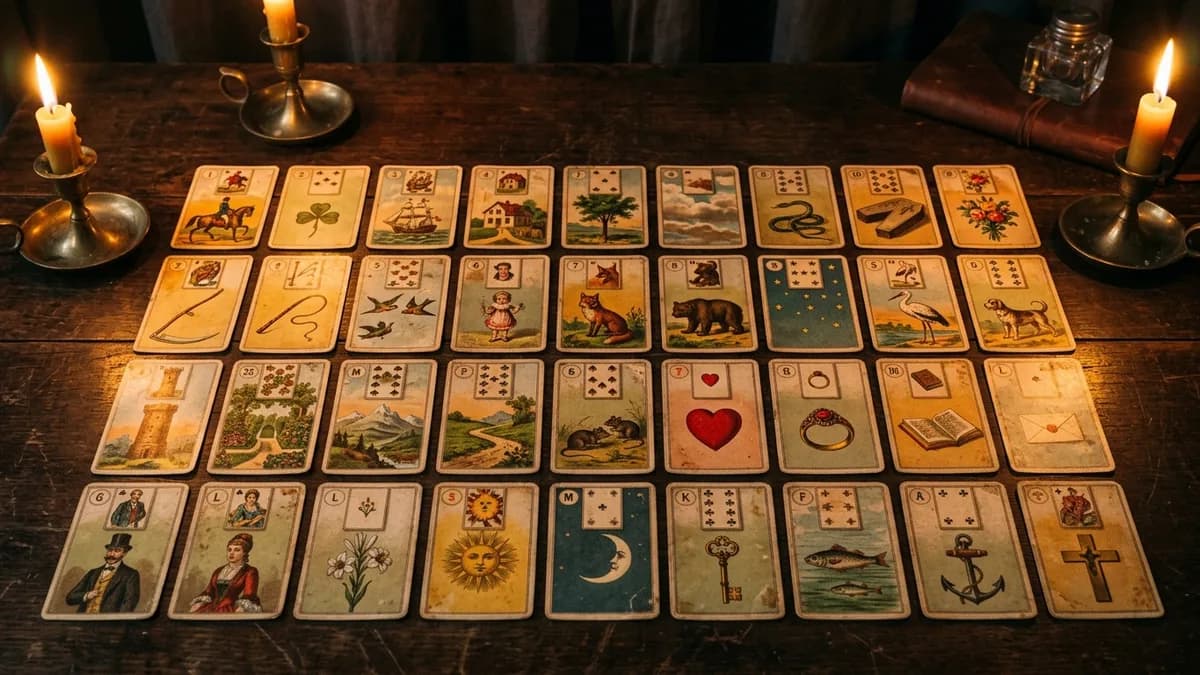
In brief: The Grand Tableau is the most complex and comprehensive divination method in the Lenormand system, using all 36 cards simultaneously. There are two main ways to lay it out: the cla

A full table of meanings for all 36 Lenormand cards – keyword and meaning for each, plus how to read them together. From Rider to Cross.