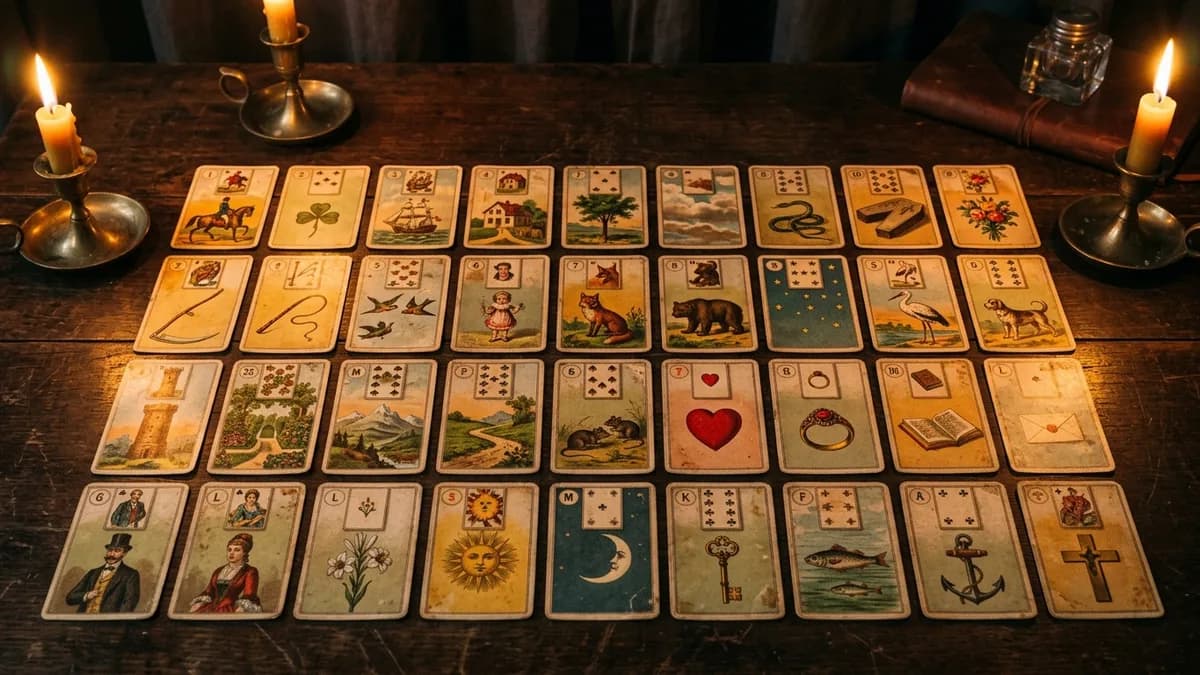
The Grand Tableau in Lenormand
In short:
- The Grand Tableau is the most complex and comprehensive divination method in the Lenormand system, using all 36 cards simultaneously.
- There are two main ways to lay out the cards: the classic 8x4+4 format (four rows of eight cards plus four cards at the bottom) and the 9x4 square format (four rows of nine cards).
- The interpretation begins by finding the Significator card – Man (28) or Woman (29), which represents the querent.
- Specific techniques are used, such as reading by rows, columns, diagonals, as well as advanced methods like the "Knight's Move," "Mirrors," and the "Houses" system.
- This 36-card Lenormand spread provides a complete picture of the querent's life – past, present, future, love, work, finances, and hidden influences, all in one layout.
What is the Grand Tableau in Lenormand
In the world of cartomancy, few methods offer as detailed and comprehensive a view of human life as the Grand Tableau Lenormand. Known in its original form as Grand Tableau (from French – "large picture" or "large table"), this spread uses the entire deck of 36 cards. Unlike smaller spreads that answer a specific question (like a line of 3 or 5 cards), the Grand Tableau is a panoramic snapshot of the querent's life at a given moment.
The Lenormand system, named after the famous French fortune-teller Marie-Anne Lenormand, was created for practicality. The cards depict real events, people, objects, and situations. When all 36 cards are laid out, they form a complex web of interconnections. Each card influences its neighbors, and the distance between certain cards reveals how near or far a given event is. This large Lenormand spread is not just a series of random meanings, but a connected narrative where the cards are read like words in sentences, paragraphs, and entire chapters of life.
The goal of the Grand Tableau is not to read every possible combination – that would take hours and lead to information overload. Mastery lies in knowing where to look, how to find the focal points, and how to trace the threads that connect the different aspects of the querent's life.
Card Layouts: 8x4+4 vs. 9x4
Before you begin the actual reading, you need to choose how you will lay out the cards. There are two established standards for the grand tableau Lenormand. The choice between them is a matter of personal preference, as both methods work flawlessly but slightly alter the visual geometry of the reading.
The Classic 8x4+4 (Piquet) Format
This is the most traditional way to lay out the Grand Tableau. It is connected to the historical roots of the cards and the game of Piquet. In this layout, the cards are arranged from left to right, row by row:
- Row 1: Cards 1 to 8
- Row 2: Cards 9 to 16
- Row 3: Cards 17 to 24
- Row 4: Cards 25 to 32
- Row 5 (Fate Row): Cards 33 to 36, centered below the middle four cards of the fourth row.
What's specific here are the last four cards. They are often called the "line of destiny" or "karmic row." These cards represent events that are beyond the querent's control, inevitable developments, or the final outcome of the current life phase. They carry particular weight in the divination.
The 9x4 Square Format
This format was created for greater symmetry and ease of tracking diagonals. The cards are again arranged from left to right:
- Row 1: Cards 1 to 9
- Row 2: Cards 10 to 18
- Row 3: Cards 19 to 27
- Row 4: Cards 28 to 36
The advantage of the 9x4 is its perfect rectangular shape. It doesn't have any "hanging" cards at the bottom, which makes techniques like mirrors and intersections much easier to visualize. There is no distinct fate row here; the cards in the last row simply represent the foundation of the situation or the immediate future.
To familiarize yourself with the basic meanings of each individual card before placing them in the grand tableau, check out our Lenormand Cards - A Complete Beginner's Guide.
First Steps in Reading: The Significant Card (Significator)
When all 36 cards are laid out before you, the initial impulse is to try to understand everything at once. This is a mistake. The first and most important step in any Lenormand 36-card spread is to find the Significator – the card that represents the person for whom the reading is being done.
If the querent is a man, you look for card number 28 (Man). If they are a woman, you look for card number 29 (Woman). This card is the anchor of the entire reading. Where it is located in the spread determines the past, present, and future.
Position and Timeline
In Lenormand, time generally flows from left to right and from top to bottom relative to the Significator. This is a basic rule, although some European schools also consider the direction the figure's face is turned in the illustration of your deck.
- The Significator's Column: The cards located in the same vertical column above and below the querent represent the present. These are the things happening right now.
- Above the Significator: The cards above the querent's head show what is on their mind, the things they are thinking about, or higher forces influencing them (often things beyond their control).
- Below the Significator: The cards at their feet are the things they control, suppress, or have stepped on. This is their foundation.
- To the Left of the Significator: This is the past. The cards immediately next to it are the recent past, and those further to the left are the distant past.
- To the Right of the Significator: This is the future. The first few cards to the right are events that will happen soon.
If the Significator falls at the very end of the spread (e.g., in the far right column), it means the querent has left everything behind them, and a period of uncertainty or a completely new beginning lies ahead, for which the cards do not yet provide information. If it is in the far left column, their entire life is ahead of them, and the future is extremely dynamic.
Key Reading Techniques in the Grand Tableau
Once you have located the querent, it's time to begin the actual reading. In Lenormand, cards are read in combinations. A single card on its own is merely a noun; the adjacent card adds an adjective or a verb. To understand exactly how this works, you can consult the article Lenormand Card Combinations - How to Read Them Together.
The 3x3 Portrait (The Inner Square)
The most direct and clear information about the querent's current state is found in the eight cards that physically touch the Significator. These form a 3x3 square (with the querent in the center). This square is read as a standalone mini-spread.
Let's assume the Woman (29) is in the center. Above her is the Snake (7), below her is the Dog (18), to her left is the Book (26), and to her right is the Letter (27).
We read: The Woman is currently focused on problems or complications (Snake above her). She is stepping on the loyalty of a friend or a secure partnership (Dog below her). In the recent past, there was a secret or learning (Book to the left), and in the very near future, she will receive news or a document (Letter to the right). The diagonal cards within this square will provide additional details on how the past flows into the future.
Reading by Rows and Columns
Rows provide ongoing timelines. If you want to track the development of a situation, read the horizontal row on which the key card is located. Each subsequent card to the right modifies the previous one and indicates the next step in events.
Columns show the intensity of the present. The vertical line in which a card is found reveals what supports the situation (the cards below) and what is pressing it (the cards above).
Diagonals
The diagonals in the Lenormand Grand Tableau are extremely powerful. They reveal hidden influences, secret motives, or unexpected developments. Diagonals are read as an additional layer of information to the horizontal timelines. If the horizontal row is what is visible on the surface, the diagonal is what is happening behind the scenes.
Advanced Techniques: Mirroring, Knighting, and Intersection
To unlock the full potential of a large Lenormand spread, you need to move beyond simply reading adjacent cards. Traditional techniques add depth and specificity that make Lenormand such a precise system.
Mirroring
The concept of mirroring is based on the physical symmetry of the layout. Cards that are in opposite positions "mirror" each other, creating a hidden connection between them.
In an 8x4 format, the first card of the first row (position 1) mirrors the last card of the first row (position 8). The second card (position 2) mirrors the seventh (position 7). The same applies to columns: the top-left card mirrors the bottom-left card. The most powerful mirrors are the four corners of the spread. They set the general theme of the entire reading. If you have the Anchor, Sun, Coffin, and Rats in the four corners, the theme is clear: security and success threatened by a sudden end and losses.
Knighting
This technique is borrowed from chess. The knight's move is in an "L" shape – two squares in one direction and one square perpendicularly. In Lenormand, you do exactly that. From a given card (e.g., the Significator), you count two positions up and one to the right, or two down and one to the left.
Knighting reveals what is "prompting" the querent, their hidden motives, things they sense intuitively but may not fully realize. If the Woman knights towards the Fox, she subconsciously senses deception or is herself planning a strategic move at work, even if her neighboring cards appear serene.
Intersection / Coordinate Meeting
When you want to understand the relationship between two people or two concepts, you use intersection. You find the Significator (e.g., Man) and another important card (e.g., Bear – the boss, or Heart – love). You draw an imaginary horizontal line from one card and a vertical line from the other. The card where these two lines intersect shows the essence of the relationship between them at the moment. If the Man and the Bear intersect on the Whip card, the relationship with the boss is filled with conflicts and arguments.
The "Houses" System in the Grand Tableau
This is perhaps the most important concept that transforms the 36 cards from a simple arrangement into a true Lenormand Grand Tableau. The system of houses is based on the sequential numbers of the cards in the deck.
Imagine that before you lay out your shuffled cards, there are already 36 invisible empty fields drawn on the table. Field number 1 is always "The Rider's House." Field number 2 is "The Clover's House." Field number 3 is "The Ship's House," and so on, up to field 36 – "The Cross's House." These houses are fixed and do not change.
When you lay out the cards, each one falls into a specific house. The reading is done by combining the card with the house it landed in. The formula is: [The Card] in the sphere of [The House].
Example: If the Fish card (money) lands in position 3 (The Ship's House – travel, distance), it could mean money coming from afar, a financial transfer from abroad, or an investment in travel.
To use this technique, you need to know the meaning of all 36 positions. Here we will examine each one in detail, as they are the backbone of this method. (For additional reference on the cards themselves, see Meaning of the 36 Lenormand Cards).
Houses 1 to 9: The Foundation of Everyday Life
- House 1 (Rider): The sphere of news, messages, rapid movement, and things entering your life. The card here shows what you will learn soon.
- House 2 (Clover): The sphere of luck, small joys, quick opportunities, and gambling. The card here is where you have a chance.
- House 3 (Ship): The sphere of travel, distance, foreign lands, trade, and longings. It shows what is moving slowly or coming from afar.
- House 4 (House): The sphere of home, family, personal comfort, real estate, and a sense of security.
- House 5 (Tree): The sphere of health, vitality, long-term development, roots, and genetics. Things here develop slowly but steadily.
- House 6 (Clouds): The sphere of confusion, uncertainty, fears, and temporary problems. The card here shows what is troubling you at the moment.
- House 7 (Snake): The sphere of complications, betrayals, rivals (often a female figure), but also of intelligence and roundabout ways.
- House 8 (Coffin): The sphere of endings, loss, transformation, illness, or the conclusion of a stage. The card here shows what is leaving your life.
- House 9 (Bouquet): The sphere of joy, gifts, beauty, social gatherings, and recognition. It shows where happiness comes from.
Houses 10 to 18: Interactions and Risks
- House 10 (Scythe): The sphere of sudden interruptions, dangers, quick decisions, operations, or aggression. The card here shows what will be "cut off."
- House 11 (Broom/Whip): The sphere of arguments, repetitive actions, physical activity, sex, and conflicts. It shows where there is tension.
- House 12 (Birds/Owls): The sphere of face-to-face communication, gossip, stress, nervousness, and double situations.
- House 13 (Child): The sphere of new beginnings, innocence, children, small things, and inexperience. The card here shows what is just starting.
- House 14 (Fox): The sphere of work, the workplace, survival, but also of deception, cunning, and manipulation. Be careful with the card that falls here.
- House 15 (Bear): The sphere of power, authority, bosses, finances (large sums), protection, and sometimes a mother figure.
- House 16 (Stars): The sphere of hopes, dreams, technology, networks, navigation, and clarity. It shows what inspires you.
- House 17 (Stork): The sphere of change, moving, improvement, and flexibility. The card here shows what will transform for the better.
- House 18 (Dog): The sphere of friendship, loyalty, trust, and people you can rely on.
Houses 19 to 27: Institutions, Relationships, and Secrets
- House 19 (Tower): The sphere of institutions, government, corporations, isolation, loneliness, and official structures.
- House 20 (Garden): The sphere of society, publicity, social networks, events, and what is visible to everyone.
- House 21 (Mountain): The sphere of obstacles, blockages, delays, coldness, and enemies. The card here shows what is stopping you at the moment.
- House 22 (Roads/Crossroads): The sphere of choices, alternatives, decisions, and free will. It shows where you need to make a decision.
- House 23 (Mice): The sphere of losses, theft, stress, gnawing illnesses, and diminishment. The card here shows what is draining you.
- House 24 (Heart): The sphere of love, romance, passion, and what you love to do. Here you seek a partner or the emotional center.
- House 25 (Ring): The sphere of contracts, marriage, commitments, cyclical events, and promises.
- House 26 (Book): The sphere of secrets, education, knowledge, projects, and things that are still hidden. The card here shows what you don't know.
- House 27 (Letter): The sphere of documents, emails, written communication, contracts (the physical medium), and results.
Houses 28 to 36: People, Final Outcomes, and Destiny
- House 28 (Man): The sphere of the querent (if male) or the most important man in the life of a female querent. The card that falls here describes the state of this man.
- House 29 (Woman): The sphere of the querent (if female) or the most important woman in the life of a male querent.
- House 30 (Lilies): The sphere of peace, old age, wisdom, retirement, but also of sexuality and morality.
- House 31 (Sun): The sphere of success, energy, victory, warmth, and the revelation of truth. This is the strongest positive house.
- House 32 (Moon): The sphere of emotions, reputation, fame, intuition, creativity, and romance.
- House 33 (Key): The sphere of security, solutions, important revelations, and a definitive "Yes." The card here is the key to solving problems.
- House 34 (Fish): The sphere of finances, business, abundance, cash flow, and independent work.
- House 35 (Anchor): The sphere of stability, long-term work, security, settling down, but also of stagnation if in a negative context.
- House 36 (Cross): The sphere of burden, suffering, karma, religion, trials, and the inevitable. The card here shows your greatest burden.
For a quick reading, you can use our free Lenormand divination tool to draw a few cards and practice combining them before moving on to the full 36.
Focus on Specific Areas: Thematic Cards
One of the biggest advantages of the Grand Tableau is that you don't need to do a new draw for every question. All the answers are already on the table. All you need to do is find the relevant Focus Card and examine it as a mini-significator for the given area.
- For Love and Relationships: Find the Heart (24) for emotions and the Ring (25) for relationship/marriage status. See which houses they landed in. Examine the cards surrounding them (their 3x3 square). For example, if the Heart is surrounded by the Coffin and the Mice, the love life is going through a difficult period of loss and stress.
- For Work and Career: Use the Fox (14) for daily work and the Anchor (35) for long-term career and stability. If the Fox is in the Tower (19) house, the person works in a large corporation or government institution.
- For Money and Finances: Find the Fish (34) for liquidity and cash, and the Bear (15) for savings, investments, or financial control. If the Fish intersects with the Paths (22), a financial choice or income diversification is imminent.
- For Health: The focus is the Tree (5). Lenormand cards do not provide medical diagnoses, but they indicate the general condition. The Tree next to the Sun signifies vitality and rapid recovery. The Tree next to the Scythe requires attention to sudden problems or surgical interventions.
If you want to learn more about how to structure your questions and choose the right layouts, read How to Read Lenormand Cards - Step-by-Step Layouts.
Practical Example: Reading a Large Lenormand Spread Step-by-Step
Let's explore a hypothetical situation to see how all these techniques work together. The querent is Maria (Woman - 29), who wants a general overview of her life. We are using an 8x4+4 layout.
Step 1: The Big Picture (The Four Corners)
In the corners of the spread (positions 1, 8, 25, 32) fall the cards: Anchor, Ring, Clouds, Sun.
Analysis: Maria is seeking stability (Anchor) in her commitments and relationships (Ring). Currently, there is uncertainty and confusion (Clouds), but the outcome will be successful and clear (Sun).
Step 2: Finding the Significator
The Woman card (29) falls on position 14 (the Fox's House). The Fox itself (14) is on position 34 (the Fish's House).
Analysis: Maria (29) is in the house of work (14). Her main focus is currently on her career and survival. Since the Fox is in the house of money (34), she is actively looking for ways to increase her income or works in the financial sector.
Step 3: The Timeline (Maria's Row)
Maria is on the second row. To her left (past) are the Tree and Coffin. To her right (future) are the Letter, Key, Rider.
Analysis: In the past, there was a long period of stagnation or a health issue that has now ended (Tree + Coffin). The future looks very dynamic: she will receive an important document or contract (Letter), which will bring a sure solution (Key) and quick news or movement (Rider).
Step 4: The 3x3 Portrait around Maria
Above her (in her mind): Tower.
Below her (her foundation): Fish.
To her left: Coffin.
To her right: Letter.
Analysis: Maria is thinking about institutions, official structures, or isolation (Tower). She is firmly grounded in financial matters (Fish). She has left a completed phase behind her (Coffin) and is expecting written communication (Letter).
Step 5: Knight's Move and Mirrors
We make a knight's move from the Woman (29). She knights towards the Dog (18) and the Stars (16).
Analysis: Subconsciously, Maria relies heavily on a loyal friend (Dog) and harbors great hopes for the future (Stars).
The mirror of the Woman (position 14 in an 8x4 layout) is position 11, where the Whip is located. This indicates hidden inner tension, stress, and a tendency towards self-criticism.
Step 6: Checking a Specific Area (Love)
We look for the Heart (24). It is located at position 36 (the Cross's House) in the destiny row. Next to it are the Mountain and Mice.
Analysis: Maria's love life is currently a source of great burden and suffering (Heart in the Cross's House). There are serious blockages and coldness (Mountain), which cause stress and exhaustion (Mice). Since these cards are in the destiny row, the situation is karmic and currently beyond her control – she simply has to go through this period.
Lenormand vs. Tarot in the Context of Grand Tableau Spreads
Beginners often ask if they can do a similar spread with Tarot. The answer is: technically yes, but the practical execution is quite different. If you lay out 36 Tarot cards, you will get a huge clash of archetypes, spiritual lessons, psychological states, and esoteric symbols. This creates an extremely heavy and often confusing reading because Tarot cards are multi-layered and abstract.
The Grand Tableau works perfectly with Lenormand precisely because of the direct nature of the cards. In Lenormand, "Dog" means friend, loyalty. It does not mean subconscious instincts or a spiritual guide, as it might be interpreted in Tarot. This specificity allows the 36 cards to function like words in a sentence, creating a clear, grounded, and practical narrative about everyday life. For a more in-depth analysis of the differences between the two systems, see Lenormand vs. Tarot - What's the Difference.
Frequently Asked Questions
How often can I do the Grand Tableau?
Since the Grand Tableau covers a vast period of time and many areas of life, it is not recommended to do it frequently. Most professionals advise doing it once every 3 to 6 months, or at most once a year (e.g., on a birthday or New Year). Doing it every day or every week will lead to confusing and inaccurate results.
What happens if the Significator is at the very edge of the spread?
If the Man or Woman falls in the far left column, it means the past is irrelevant at the moment, and a completely new path opens up for the querent (all cards are in the future). If they fall in the far right column, the querent is focused on the past and does not clearly see their future, or a period of stagnation is approaching for which the cards provide no information.
Should I use reversed cards in the Grand Tableau?
No. The traditional Lenormand system does not use reversed cards. The meaning of a card – whether it manifests in its positive or negative light – is determined entirely by the cards surrounding it and the house it has fallen into.
Which option is better: 8x4+4 or 9x4?
There is no "better" option. The 8x4+4 format is more traditional and gives additional weight to the last four cards (the destiny row), which many readers find helpful. The 9x4 format is more symmetrical and makes tracing diagonals and intersections visually easier. Try both methods and choose the one that feels more intuitive to you.
What does it mean if two thematic cards are very far apart?
In Lenormand, distance matters. If, for example, you are asking about the relationship between the Man (28) and the Woman (29) and they are at opposite ends of the tableau, it indicates an emotional, physical, or psychological distance between them. They live in different worlds. The closer two cards are, the stronger their interaction.
Can I read the Grand Tableau for just one specific question?
Yes, that is entirely possible. Although the tableau shows the whole life, you can simply find the card corresponding to your question (e.g., the Anchor for work) and read only its 3x3 square, the houses, and the lines around it, ignoring the rest of the spread. However, this takes time to lay out, so for single questions, lines of 3, 5, or 7 cards are usually preferred.
Card readings are a tool for self-discovery and reflection. The information in this article is for educational purposes and does not replace professional medical, psychological, or financial advice. For important life decisions, consult a specialist.
Comments
Related Guides
Explore more guides in Guides

How to Read Lenormand Cards - Step-by-Step Guide
In short: The Lenormand system consists of 36 cards with specific, everyday meanings (money, work, news, people), which are read together like words in a sentence…

Lenormand Cards - A Complete Beginner's Guide
In short: Lenormand cards are a practical divination system consisting of 36 cards with clear, everyday symbols (House, Dog, Letter, Coffin). Unlike Tarot, Lenormand…

Lenormand vs. Tarot - What's the Difference
In short: The system: Tarot consists of 78 cards, divided into Major and Minor Arcana, and works with deep psychological and spiritual archetypes. Lenormand has 36 cards…