The natal chart, also known as a birth chart, is an astrological "snapshot" of the sky at the precise moment of your birth, determined by geographical coordinates and time. It serves as a unique cosmic imprint that reveals an individual's psychological profile, potential talents, karmic lessons, and life path. Through the analysis of planets, houses, and zodiac signs, the natal chart provides tools for self-discovery and personal development.
Learn more in our guide: Planets in Astrology - An Overview.
Astrology is an ancient discipline that is fundamentally not just a predictive system, but a complex language of symbols describing the human psyche and its connection to the Cosmos. At the heart of this language is the natal chart. Imagine that at the moment you took your first breath, the Universe paused to capture the position of all celestial bodies relative to the horizon of your location. This configuration is your birth chart – a mathematically calculated diagram that serves as a navigational map for your entire life.
Learn more in our guide: The Sun in Astrology.
Many people mistakenly believe that astrology is limited to just your "zodiac sign" (sun sign). In reality, the Sun is only one of many factors in a natal chart. A complete analysis requires examining the Moon (emotions), Mercury (intellect), Venus (love), Mars (action), and the other planets, all positioned within specific signs and astrological houses. Each of these elements interacts with the others through "aspects" – angular distances that determine whether energies will cooperate or create tension.
Why is it important to know your natal chart? In today's world, filled with noise and external expectations, we often lose touch with our authentic selves. The natal chart acts as a mirror, showing us why we react in certain ways, what our innate talents are, and what recurring challenges we face. It is not a fatalistic decree; it is a spectrum of possibilities. The planets do not "force" us to do anything, but they describe the energetic currents we move within. Understanding these currents allows us to exercise our free will more consciously.
Over the centuries, natal astrology has evolved from a tool for kings and rulers to a powerful psychological system used by Carl Jung and his followers. Jung believed that astrology represented the sum of humanity's ancient psychological knowledge. Today, with the help of modern technology, calculating a chart takes seconds, but its interpretation remains an art that requires depth, intuition, and knowledge of archetypes.
To understand a natal chart, we must first familiarize ourselves with its four fundamental components: the planets, the signs, the houses, and the aspects. They are often described using a theatrical metaphor: the planets are the actors, the signs are the roles they play, the houses are the stages (areas of life) where the action unfolds, and the aspects are the script – how the actors interact with each other.
Learn more in our guide: Natal Chart: Analysis of Houses and Planetary Dominance.
In astrology, the term "planets" includes the Sun and Moon (called Luminaries), as well as Mercury, Venus, Mars, Jupiter, Saturn, Uranus, Neptune, and Pluto. Each planet represents a specific function of human consciousness:
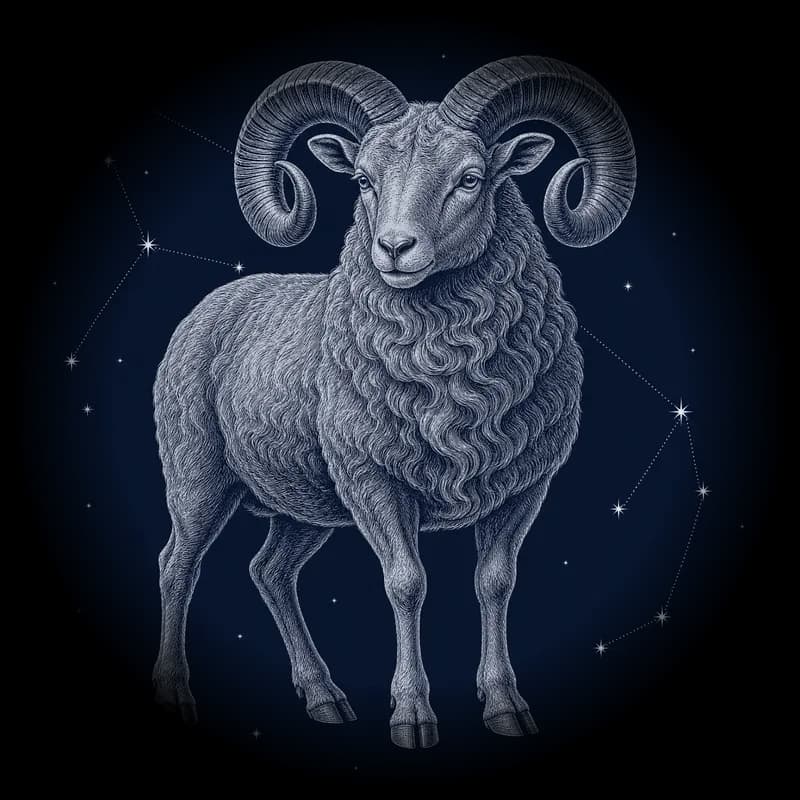
The zodiac signs (from Aries to Pisces) are the 12 filters through which planetary energies manifest. They are divided by elements (Fire, Earth, Air, Water) and by modalities (Cardinal, Fixed, Mutable). For example, if Mars is in Aries (a fiery, cardinal sign), the energy is impulsive and direct. If Mars is in Taurus (an earthy, fixed sign), the action is slow, persistent, and methodical.
While planets and signs are universal, houses are strictly individual and depend on the exact time and place of birth. They divide the celestial sphere into 12 sectors, each corresponding to a specific area: from personal identity (1st house) to career (10th house) and the subconscious (12th house). The Ascendant (rising sign) marks the beginning of the 1st house and is one of the most important points in the chart.
Aspects are the geometric angles between planets. They indicate whether planets are working in harmony (trine, sextile) or in conflict (square, opposition). A conjunction is the most powerful aspect, where two planets merge into a single shared energy.
The Ascendant (ASC) is the sign that was rising on the eastern horizon at the moment of your birth. It determines the physical body, outward appearance, and the "mask" we wear in public. If the Sun is your essence and the Moon is your soul, then the Ascendant is your style of interaction. It also determines the layout of the houses in the chart. A person with an Aries Ascendant will approach the world with caution and intensity, while a person with a Sagittarius Ascendant will be open, curious, and adventurous.
These planets move quickly and are unique to the individual. They describe our daily reactions and personality traits.
The Sun is the heart of the chart. It shows where we want to shine and what our core life purpose is. In Leo, it seeks recognition; in Virgo, it seeks perfection through service to others. The Moon is no less important; it is our emotional sanctuary. A Moon in Cancer needs home and family to feel secure, while a Moon in Aquarius seeks freedom and intellectual stimulation.
Jupiter and Saturn represent our connection to society and law. Jupiter shows where we have the greatest potential for growth and abundance. Saturn, on the other hand, is the "Lord of Karma." It points to our greatest fears and insecurities, but also to the areas where, through hard work, we can achieve the greatest mastery. The Saturn return (around age 29) is a key moment of maturation for every person.
These planets move extremely slowly and describe entire generations. Their effect in an individual chart is felt most strongly when they make aspects to personal planets or are in "angular" houses (1, 4, 7, 10). Uranus is the planet of revolution and sudden change. Neptune governs dreams, spirituality, but also illusions. Pluto is associated with transformation, death and rebirth, as well as deep psychological power.
| House | Key Area | Description |
|---|---|---|
| 1st House | Self, Persona | Appearance, first impression, physical body. |
| 2nd House | Resources, Values | Money, possessions, self-esteem, talents. |
| 3rd House | Communication | Siblings, short trips, early education. |
| 4th House | Home, Roots | Family, origins, emotional foundation (IC). |
| 5th House | Creativity, Joy | Children, romance, hobbies, entertainment. |
| 6th House | Health, Work | Daily routine, habits, service, colleagues. |
| 7th House | Partnerships | Marriage, business contracts, open enemies (Descendant). |
| 8th House | Transformation | Shared resources, inheritance, occultism, sex, crises. |
| 9th House | Wisdom | Higher education, religion, long-distance travel. |
| 10th House | Career | Public status, ambitions, authority (MC). |
| 11th House | Communities | Friends, hopes, dreams, group causes. |
| 12th House | Subconscious | Spirituality, isolation, hidden enemies, karmic debts. |
To illustrate how a natal chart works, let's consider a few hypothetical scenarios. Interpretation is not just a collection of meanings, but a synthesis.
Imagine a person with the Sun in Aries and the Moon in Cancer. The Sun in Aries wants to be first, to fight, to be independent and bold. However, the Moon in Cancer craves emotional security, comfort, and is strongly attached to family. This individual may experience internal tension (a square) between their desire to embark on new adventures and their need to stay in the "safe nest." The solution to this conflict lies in finding balance – for example, by being a leader in defending family values.
Venus is the planet of harmony and beauty. When it is located in the 10th house (career and public status), the person is often perceived as charming and diplomatic in their professional environment. Such an individual may succeed in fields like art, design, public relations, or law. Their career is often associated with aesthetics or building harmonious relationships.
The 7th house is the house of marriage and serious partnerships. Saturn here can bring delays in marriage or a sense of great responsibility towards a partner. Often, these individuals choose older or more mature partners. Although it may seem like a limitation at first, Saturn in the 7th house promises exceptionally stable and long-lasting relationships after the age of 30, built on a solid foundation.
A stellium is a cluster of three or more planets in one sign or house. If someone has Mercury, Venus, and Mars in the 1st house, all their energy is directed towards self-expression. This person will be extremely noticeable, active, and focused on their personal projects. Their identity is strongly emphasized, and they have a huge influence on others simply by their presence.
The balance of elements in a natal chart indicates a person's overall temperament.
| Element | Signs | Characteristic | Excess of Element | Lack of Element |
|---|---|---|---|---|
| Fire | Aries, Leo, Sagittarius | Enthusiasm, action | Impulsivity, egocentrism | Lack of motivation, pessimism |
| Earth | Taurus, Virgo, Capricorn | Practicality, stability | Materialism, stubbornness | Difficulty grounding |
| Air | Gemini, Libra, Aquarius | Intellect, communication | Living in the clouds, coldness | Difficulty communicating |
| Water | Cancer, Scorpio, Pisces | Emotion, intuition | Oversensitivity, chaos | Difficulty expressing feelings |
A natal chart is not a crystal ball. It indicates potential events and periods of growth or challenges through transits and progressions. It describes the "weather" in your life, but how you use that period depends on your free will.
The exact time is critical for determining the Ascendant and houses. If you don't know it, an astrologer can perform a "rectification" – a process of calculating the time based on significant past events in your life.
Your natal chart remains the same from birth to death. It is your root. However, through the transits of planets in the present moment, you evolve and change the way you express this potential.
There is no such thing as a bad chart. Every configuration has its challenges and gifts. A chart with many difficult aspects (squares) often belongs to exceptionally successful and strong individuals who have learned to overcome difficulties.
If there are retrograde planets in your chart (marked with 'R'), it means the energy of that planet is directed more inward. For example, a retrograde Mercury can give a deep, introspective mind that processes information differently from the standard way.
The Sun sign is your essence and ego – what you are becoming. The Ascendant is how the world sees you and how you initiate new endeavors. Often, people perceive us by our Ascendant before they get to know our Sun.
The North and South Nodes (Rahu and Ketu) are not planets but mathematical points. They indicate your karmic direction. The South Node is what you have already mastered from past lives, and the North Node is the direction your soul needs to develop in this life.
The natal chart is much more than a list of planetary positions; it is a living, breathing system that reflects the complexity of human existence. In a world that often makes us feel like small particles in a mechanical universe, astrology reminds us that we are deeply connected to the cosmic rhythm. Every aspect, every sign, and every house in our chart are pieces of the puzzle that make up our unique personality.
Studying your natal chart is a lifelong journey. At first, you may feel overwhelmed by the information, but over time, you will begin to see how the symbols come alive in your daily life. You will understand why you attract certain people, why you experience difficulties in some areas and ease in others. This understanding brings immense liberation – the liberation to be yourself, unapologetically.
It is important to remember that astrology is not meant to limit us. If you see a "difficult" aspect in your chart, do not accept it as a curse. Accept it as an invitation to work. The greatest diamonds are formed under the greatest pressure. Similarly, the strongest character traits are often forged in the zones of greatest astrological tension.
Ultimately, the natal chart is a tool for empowerment. It gives us the language to describe our inner world and the map to navigate the outer one. When we know our cosmic code, we cease to be victims of circumstances and become conscious creators of our destiny. The sky does not tell us what will happen; it tells us who we are while things are happening. And in this knowledge lies true freedom.
Disclaimer: Astrology is a system of symbolic interpretation and personal development. The information in this article is for educational purposes and should not replace professional advice in the fields of psychology, medicine, or law. The interpretation of a natal chart is a subjective art.
Професионални астролози и таро експерти
Ние сме екип от опитни астролози, таролози и нумеролози с над 15 години практика в окултните науки. Нашата мисия е да направим древната мъдрост достъпна и разбираема за всеки, който търси пътеводител в живота си.
Какво ви свързва наистина?
Съвместимост между две натални карти. Любов, приятелство или бизнес партньорство.
Разгледай останалите ръководства или изследвай astrology.
Разгледай още ръководства от категория Планети

TLDR: Saturn, the planet of karma, discipline, and limitations, plays a key role in our Natal Chart. It teaches us responsibility, builds structure, and helps us achieve long-term goals.

Jupiter, the largest planet in our Solar System, symbolizes expansion, luck, abundance, and higher knowledge in astrology. Its position in your Natal Chart reveals the areas where you seek

TLDR: Mars in a natal chart symbolizes our energy, motivation, aggression, passion, and how we take action. It governs impulse, desire, and the drive to achieve goals. Its position...