
Meaning of the 36 Playing Cards
In short:
- Traditional fortune-telling uses a deck of 36 cards (from 6 to Ace in all four suits).
- Each suit corresponds to a specific area of life: Hearts are emotions, Diamonds – money and news, Clubs – work and luck, and Spades – weather, obstacles, and official institutions.
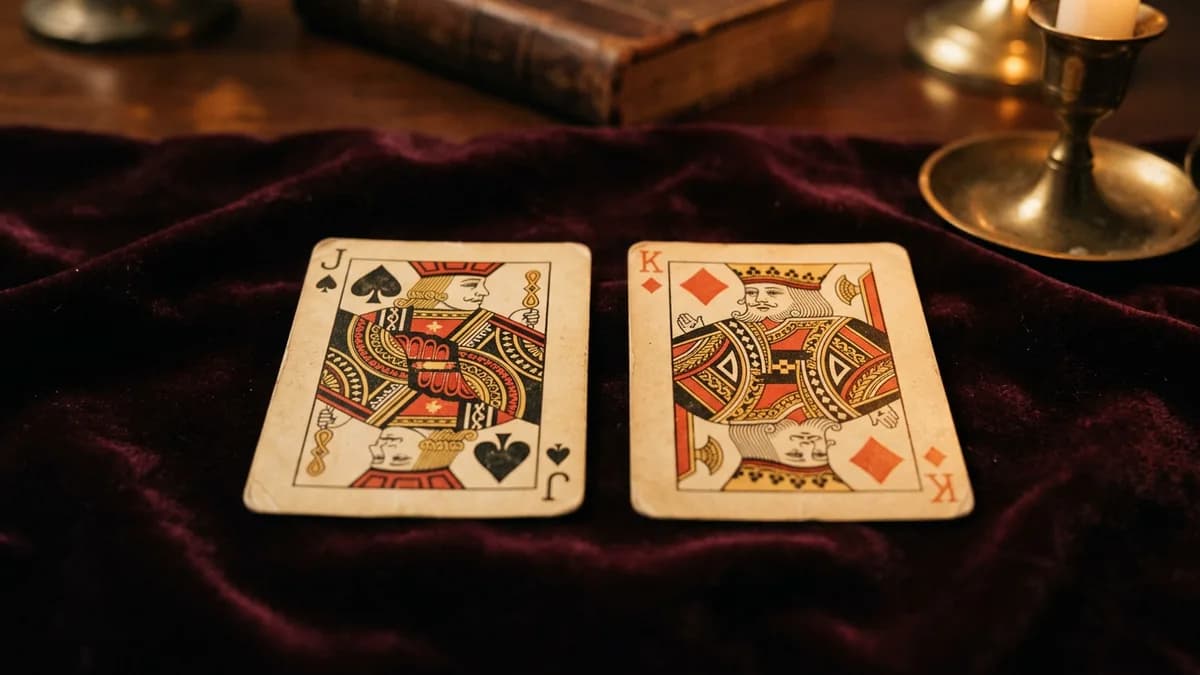
- Face cards (Jack, Queen, King) most often represent real people in the querent's circle.
- The small cards (6 to 10) describe events, journeys, conversations, and timeframes.
- Cards are never read in isolation – their meaning changes based on the neighboring cards in the spread.
The Language of a Standard Deck: How to Understand the Cards
When you hold a standard deck of 36 playing cards in your hands, you're not just holding paper. You're holding a small, very accurate model of human daily life. Unlike other systems that speak in complex philosophical symbols, here the cards are direct, clear, and often brutally honest. They don't talk to you about karma and past lives. They tell you if you'll get money on Thursday, if that person is thinking about you, and if the journey you're planning will go smoothly.
To understand the full meaning of playing cards, you need to stop seeing them as individual pictures. They are a community. The face cards are the people around you – your relatives, colleagues, friends, and enemies. The small cards are the things these people do – their conversations, travels, worries, and joys. If you want to delve deeper into the framework of this system, you can explore our Fortune-Telling with Playing Cards - A Complete Guide.
The basic rule for any 36-card meaning is simple: the suit sets the tone. If red cards predominate in a reading, the situation is active, emotional, related to people and movement. If black cards predominate – we have delays, work, institutions, or obstacles. You can learn more about this balance in the article on The Meaning of Suits in Fortune-Telling with Cards.
Below you will find a concise reference for each suit. It is designed to serve as a quick reference when you lay out the cards on the table. Do not memorize the meanings by heart. Try to feel their logic – how the six always represents some kind of journey or movement, how the seven is a conversation, and the ten is a culmination or great interest.
Hearts: Love, Family, and Emotions
Hearts are the heart of the deck. They represent our deepest feelings, family comfort, romantic stirrings, and the people who are truly close to us. When Hearts predominate in a reading, the question always comes down to emotions, even if the querent thinks they are asking about work. They soften the bad cards around them and bring hope.
| Rank | Keyword | Brief Meaning |
|---|---|---|
| 6 | Journey | An early journey, a pleasant walk, or meeting a loved one. |
| 7 | Conversation | A heartfelt conversation, sharing feelings, pleasant words. |
| 8 | Joy | Satisfaction, shared time, pleasant emotions, and peace. |
| 9 | Love | Sincere feelings, infatuation, sometimes a pleasant surprise. |
| 10 | Home | Family hearth, stability in relationships, a wedding, or cohabitation. |
| Jack | Thoughts | The thoughts of a loved one, romantic stirrings, or simply a young admirer. |
| Queen | Woman | The querent herself (if fair/single) or a very close woman (mother, sister). |
| King | Man | The querent (if male) or a mature, married man with good intentions towards you. |
| Ace | Family | The paternal home, a strong family bond, great joy, or celebration. |
Diamonds: Money, News, and Dynamics
Diamonds are the engine of daily life. This suit connects to the material world, not with large, static wealth, but with circulating money. This includes our salaries, bills, small purchases, as well as the news we await. Diamonds are fast cards – they indicate events that happen soon. The face cards here often represent young, energetic people or those with whom we have business, but not strictly formal, relationships.
| Rank | Keyword | Brief Meaning |
|---|---|---|
| 6 | Short Journey | A short trip, running errands, a business trip, or a quick change of plans. |
| 7 | Deal | Minor financial matters, buying and selling, a business conversation. |
| 8 | Meeting | A business or friendly meeting, discussing money or plans. |
| 9 | Money | Financial inflow, earning money, an independent sum. |
| 10 | Interest | Large sums of money, serious business interest, anticipation of good profit. |
| Jack | News | An important message, a letter, a phone call, or a young person (colleague). |
| Queen | Young Woman | An unmarried woman, a colleague, a friend, and sometimes a rival. |
| King | Young Man | A single man, a business partner, or someone who brings you important news. |
| Ace | Document | An important paper, contract, official letter, or notice related to money. |
Clubs: Work, Stability, and Luck
Clubs are the backbone of our social and professional lives. They represent career, long-term efforts, stability, and official matters. Unlike Diamonds, which are quick money, Clubs represent steady income and established positions. They are also the cards of luck – the kind of luck that comes as a result of hard work. The face cards in Clubs are authoritative people, bosses, patrons, or older relatives.
| Rank | Keyword | Brief Meaning |
|---|---|---|
| 6 | Evening Journey | A work-related trip, a late departure, or a long-awaited event. |
| 7 | Success | Success in endeavors, a productive conversation, support from colleagues. |
| 8 | Work | Daily duties, routine, stability in career and business. |
| 9 | Luck | A fortunate coincidence, an unexpected acquisition, a gift, or a strong chance. |
| 10 | Change | A major change at work, a promotion, or significant financial success. |
| Jack | Concerns | Work commitments, running errands, a busy daily life, or a young colleague. |
| Queen | Mature Woman | A business woman, a boss, a woman of status, authority, and opportunities. |
| King | Mature Man | An influential man, a patron, a boss, a father, or someone who can help. |
| Ace | Institution | A government building, a bank, a large company, or a definitive, major success. |
Spades: Challenges, Time, and Warnings
Spades often frighten beginners, but without them, the deck would be unrealistic. Life isn't just about love and money. Spades represent difficulties, delays, illnesses, and conflicts. They are the cards of distance and coldness. At the same time, Spades often symbolize time – long periods, late hours of the day, or winter months. The face cards in Spades can represent official figures (doctors, judges, military) or people who are not favorably disposed towards us.
| Rank | Keyword | Brief Meaning |
|---|---|---|
| 6 | Late Journey | A long journey, a postponed departure, or a journey that doesn't bring the expected joy. |
| 7 | Tears | Bitterness, minor worries, gossip, anxiety, or disappointment. |
| 8 | Argument | A quarrel, conflict, unpleasant conversation, disagreement, or tension. |
| 9 | Illness | Physical discomfort, emotional breakdown, or the end of a situation. |
| 10 | Blow | A sudden problem, a sharp change, the collapse of plans, or severe stress. |
| Jack | Empty Hopes | Futile efforts, deception, a false friend, bad thoughts, or failed plans. |
| Queen | Malice | An intrigante, a widow, a woman who intentionally harms or harbors strong envy. |
| King | Official Figure | A strict man, a judge, a doctor, someone you depend on, or an open enemy. |
| Ace | End/Time | A heavy blow and a final end (if the point faces up); or simply evening/winter (if it faces down). |
How to Connect Cards into a Narrative
Knowing the meaning of each individual card is only the first step. True cartomancy begins when you start reading them together. A card never stands alone. It's like a word in a sentence – its meaning is shaped by the words before and after it.
For example, if you draw the 9 of Hearts (Love), that's wonderful. But if immediately followed by the 8 of Spades (Argument), it's no longer just love, but a love quarrel, jealousy, or tension in the relationship. If you have the 7 of Diamonds (Deal) and next to it falls the Ace of Clubs (Institution/Bank), this clearly indicates taking out a loan, signing a contract with a company, or an official financial agreement.
To learn to see these connections smoothly, without hesitation, requires practice. A detailed guide on how cards interact can be found in our material on Playing Card Combinations - How to Read Them Together. And if you want to quickly test how these meanings work in a real situation without laying out a physical deck, try our free playing card fortune-telling.
Frequently Asked Questions
Why are exactly 36 cards used, not the full 52-card deck?
The tradition of reading with 36 cards is deeply rooted in Eastern Europe and the Balkans. Cards from 2 to 5 are considered superfluous, as they dilute the information with too many minor, insignificant details. The system from 6 to Ace is sufficiently concentrated to provide clear and accurate answers about specific events and people, without confusing the querent.
What does it mean if there is a predominance of one suit in the spread?
If you draw predominantly Hearts, the situation is highly emotional and the focus is on relationships. A majority of Diamonds indicates a period of financial activity, running errands, and a lot of communication. A prevalence of Clubs speaks of concentration on work, career, and settling official matters. If Spades predominate, you are going through a difficult period filled with delays, stress, or the need to clear up old problems.
Do Spades always portend something bad?
Not always. Although they often carry warnings of problems or tears, Spades also have a practical meaning. They indicate time (evening, night, winter), distance, or official structures. For example, the King of Spades could simply be your doctor or lawyer, not necessarily an enemy. It's important to look at the cards surrounding the Spade – if they are positive (e.g., Hearts or Clubs), the problem will be resolved quickly.
How can I identify a specific person in the cards?
People are usually identified by age, marital status, and appearance. Unmarried and younger people are often Diamonds (or Jacks). Married individuals or people with a gentler nature are Hearts. Businessmen, bosses, and older relatives are Clubs. People in uniform, officials, or people with difficult personalities are Spades. When laying out the cards, you can pre-designate a Queen or King for the specific person you are asking about.
Do reversed cards have meaning in a standard deck?
In traditional playing card cartomancy, most cards are not read reversed because they are symmetrical (e.g., the 8 of Diamonds looks the same in both directions). However, there are a few asymmetrical cards whose meaning changes slightly. The most famous example is the Ace of Spades. If the point of the spade faces upwards, it signifies a heavy blow, shock, or end. If the point faces downwards (like a heart), it is read more softly – as late time, a celebration with alcohol, or simply the winter season.
How do I start laying out cards after knowing their meanings?
It's best to start with simple 3 or 5-card spreads to get used to reading them like a sentence. Don't jump into complex Gypsy spreads with the whole deck right away. If you want to see the exact steps for shuffling, cutting, and laying out the cards, review How to Tell Fortunes with Playing Cards - Step-by-Step Layouts.
Fortune-telling with cards is a tool for self-knowledge and reflection. The information in this article is for educational purposes and does not replace professional advice. For important decisions, consult a specialist.
Comments
Related Guides
Explore more guides in Guides

How to Read Playing Cards - Step-by-Step Guide
In brief: Traditional playing card readings use a 36-card deck (from Six to Ace in all four suits). A well-posed question is half the answer. Avoid yes/no questions

Playing Cards vs. Tarot and Lenormand - Which System
In brief: Standard playing cards (36 cards): The most accessible and direct system. They clearly answer everyday questions (money, work, specific people's intentions)…
Playing Card Combinations - How to Read Them Together
In short: A single card only gives the theme, but true divination happens when we read playing cards together. They form sentences. The method is simple: the first card…