
Playing Cards vs. Tarot and Lenormand - Which System
In short:
- Standard Playing Cards (36 cards): The most accessible and direct system. They answer everyday questions clearly (money, work, intentions of specific people). They rely heavily on suits and combinations.
- Tarot (78 cards): A deep, psychological system based on archetypes. Ideal for questions starting with "Why?" and for analyzing inner states and spiritual lessons.
- Lenormand (36 cards): A practical system that works like a language. Cards are read in pairs and triplets (noun + adjective). It answers "What will happen?" questions with extreme accuracy.
- The choice depends on the question: For a quick answer about daily life, use playing cards. For analyzing a complex life crisis – Tarot. For specific event development – Lenormand.
Which Divination System to Choose: First Steps in the World of Cards
People often come to me wanting to learn card reading, but they feel lost amidst the vast selection. Nowadays, there are thousands of decks, each with its beautiful imagery, thick instruction booklets, and promises of mystical revelations. The truth is, when you choose which divination system to start studying, you're not just choosing pictures. You are choosing a language through which you will converse with fate, your intuition, or your subconscious – call it whatever feels right to you.
Many beginners wander between the three main pillars of cartomancy: classic Tarot, the Lenormand oracle, and the old, familiar playing cards known to every grandmother. Each of these systems has its own character, its own vocabulary, and its own specifics. There is no "better" or "stronger" system. There is only one that is more suitable for the specific question and for your personal way of thinking.
If you are a person of clear facts, who wants to know if their salary will be raised next month, one system will serve you wonderfully. If you are someone who analyzes their childhood traumas and seeks their spiritual purpose – another will be more useful. In this article, we will honestly and without unnecessary mysticism examine what playing cards are versus Tarot and Lenormand, so you can make your informed choice.
Standard Playing Cards: Honest, Direct, and Always at Hand
Let's start with the oldest, most accessible, and often most underestimated tool. A standard deck of 36 cards (from Six to Ace in each of the four suits) is the classic of traditional fortune-telling. These are the cards our grandmothers in the village used, hidden in dim light, relying on meanings passed down by word of mouth. To delve seriously into this subject, I recommend looking at Fortune Telling with Playing Cards - A Complete Guide.
Structure and Logic of the 36 Cards
With standard playing cards, we don't have pictures to hint at the meaning. We don't have drawn angels, falling towers, or lovers. We only have numbers, figures, and suits. It is precisely this lack of visual cues that makes the system so direct. You are not distracted by the details of the illustration but read the raw energy of the suit and the number.
The foundation here is the four suits, which color the entire reading. Hearts are the blood of the reading – they show emotions, love, family, and what lies close to our heart. Diamonds are the ringing coins and rustling letters – they bring news, money, short trips, and dynamics. Clubs are the sweat on the brow – they speak of work, business, official institutions, and practical luck. Spades are the cold wind – they bring challenges, waiting periods, illnesses, but also the wisdom that comes after overcoming hardship. You can read more about this foundation in the article on The Meaning of Suits in Card Readings.
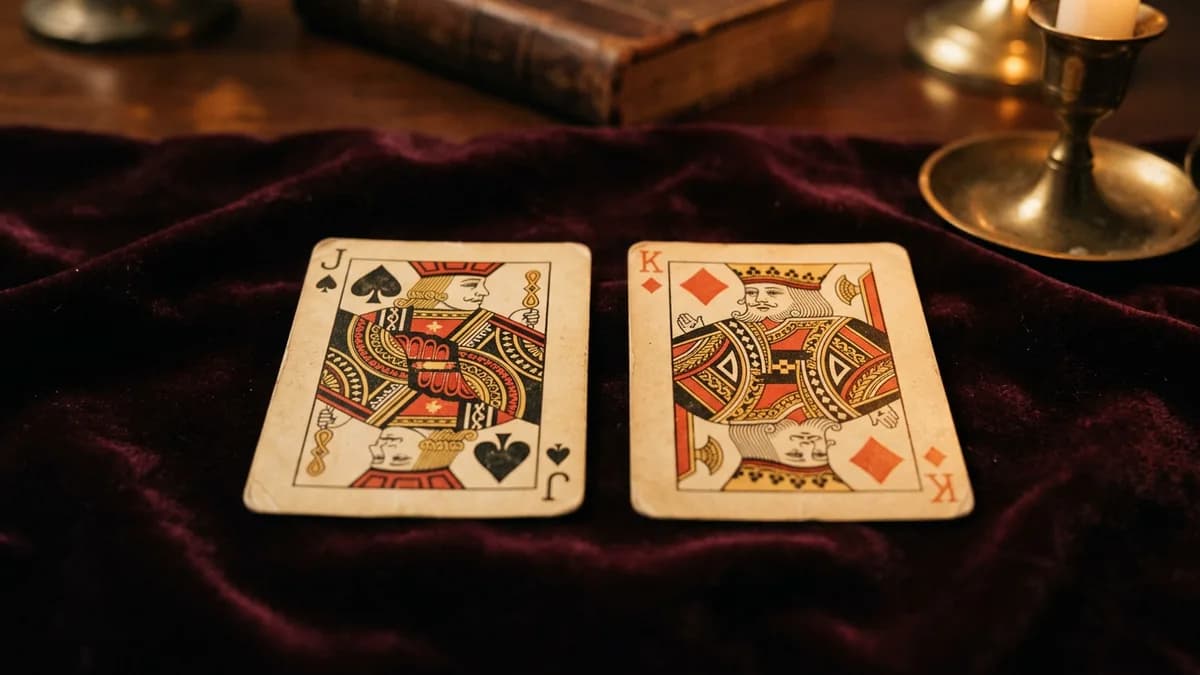
A peculiarity of this system is the face cards. Jacks, Queens, and Kings almost always represent real people in the querent's circle. The King of Hearts is a loving man or husband, the Queen of Spades is a colleague or businesswoman, the Jack of Spades is a young man with problems or secret intentions. When these cards fall on the table, you literally see who is interacting with whom.
What Questions Are They Most Suitable For
Playing cards are unsurpassed for practical, everyday questions. They do not like philosophizing. If you ask a standard deck, "What is my karmic lesson in this life?", it will likely answer something like, "You'll have trouble at work because of some money, but then you'll find peace at home." They are down-to-earth.
Use them for questions like:
- What does a specific person think and feel about me?
- Will I receive the expected money by the end of the month?
- How will the situation at my workplace develop?
- Is there a third person in our relationship?
How They Are Read in Combination
A single playing card is rarely read alone. The strength of this system lies in combinations. They are read like sentences, with the predominant suit setting the overall tone. If you have mostly red cards on the table, the answer is positive and quick. If black cards, especially spades, prevail, things will proceed slowly and with obstacles.
For example, if you draw the Ten of Diamonds (big money) next to the Eight of Spades (work, business conversation), it's a clear sign of financial success through business negotiations. However, if the Seven of Spades (tears, disappointment) appears next to them, it means the negotiations will happen, the money might be agreed upon, but there will be a lot of nerves and an unpleasant feeling in the end. To fully understand this mechanic, see Playing Card Combinations - How to Read Them Together.
Tarot: A Deep Dive into the Human Soul
If playing cards are a conversation with an old, wise neighbor who tells you things straight to your face, then Tarot is a session with an experienced psychoanalyst who makes you reflect on the root causes of your problems. Tarot is a rich, complex, and visually saturated system that requires time and patience to study.
The Structure of the 78 Cards
A classic Tarot deck consists of 78 cards, divided into two main groups: the Major Arcana (22 cards) and the Minor Arcana (56 cards). The word "arcana" itself means secret.
The Major Arcana are the backbone of Tarot. They represent the major life lessons, karmic events, and archetypes that every person goes through. They begin with The Fool (new beginnings, a leap into the unknown) and end with The World (completion, achievement of the goal). When many Major Arcana appear in a reading, it's a sign that the situation is extremely important for the querent's spiritual development and is often beyond their direct control.
The Minor Arcana are divided into four suits (Wands, Cups, Swords, and Pentacles), which correspond to the suits in standard playing cards (Clubs, Hearts, Spades, and Diamonds). They represent our daily lives, moods, thoughts, and actions. Wands are passion and energy, Cups are emotions, Swords are intellect and conflicts, and Pentacles are the material world.
What Questions Is Tarot Most Suitable For
Tarot shines brightest when you ask questions that seek depth, advice, and understanding of internal processes. The system is designed to show not only what is happening but also why it is happening.
Suitable questions for Tarot are:
- What do I need to learn from this difficult relationship?
- What is the one thing holding me back from achieving professional success?
- What energy should I embody to get through this crisis?
- Why do I keep attracting the same type of partners?
How Tarot Is Interpreted
Unlike standard cards, where combination is everything, in Tarot, each card is a whole universe. It has its own meaning, which changes depending on its position in the spread. If you use the classic Celtic Cross, the card in the "Past" position is read one way, and the same card in the "Hopes and Fears" position – quite another.
Tarot relies heavily on intuition and the visual symbols within the cards themselves. If you draw the Three of Swords (a card depicting a heart pierced by three swords), you immediately feel the pain, betrayal, or sorrow, without even knowing the keywords from the booklet. Tarot makes you tell a story through pictures, connecting them to the querent's psychological state.
Lenormand: The Practical Language of Symbols
The Lenormand system (named after the famous French fortune-teller Marie Anne Adelaide Lenormand, although the deck was created after her death) is the golden mean between standard playing cards and Tarot. It combines the concreteness of playing cards with the visual clarity of symbols.
Structure and Logic of the 36 Symbols
The classic Lenormand deck also has 36 cards. Each card has a clear, unambiguous symbol: Rider, Clover, Ship, House, Tree, Snake, and so on. In many decks, a small image of the corresponding standard playing card is also present in the corner of the card (e.g., the Rider is associated with the Nine of Hearts), indicating the historical connection between the two systems.
The logic of Lenormand is strikingly simple but requires iron discipline. The symbols are literal. The House means home or real estate. The Ship means travel or distance. The Fox means work or cunning/deception. The Dog means friend or loyalty. There is no room here for deep psychological reflections on how the Dog represents "your inner striving for unconditional love." The Dog is simply a friend.
What Questions Is Lenormand Most Suitable For
Lenormand is the absolute champion when it comes to predicting specific events. The system works like a telegram – short, precise, and without unnecessary emotions. It describes facts as they are.
Use Lenormand for questions like:
- What will be the development of this project over the next three months?
- Will I sign this contract?
- What is this person's health status? (The Tree often indicates health).
- Will I move to a new home soon?
The Grammar of Lenormand
If Tarot is poetry, and standard playing cards are a conversation at the table, then Lenormand is strict grammar. Cards are read strictly in pairs and triplets, with the first card being the noun and the second being the adjective describing it. The order of the cards completely changes the meaning.
Let's take the cards Ring (contract, marriage, commitment) and Mice (loss, stress, reduction).
If you draw Ring + Mice: We have a contract (noun) that is being eaten/lost (adjective). This means the dissolution of a contract or the end of a relationship.
If you draw Mice + Ring: We have stress/loss (noun) that is recurring or tied to a contract (adjective). This could mean a contract that causes you constant stress, or a commitment to a situation of lack.
Lenormand also uses the so-called "Grand Tableau," where all 36 cards are laid out at once to see the overall picture of the querent's life. This is a complex but extremely accurate technique.
Playing Cards vs. Tarot and Lenormand: Key Differences in Practice
To systematize the information and make your choice easier when you're wondering between Tarot or playing cards (or Lenormand), let's look at the main differences in a comparative table.
| Characteristic | Playing Cards (36) | Tarot (78) | Lenormand (36) |
|---|---|---|---|
| Main Focus | Daily life, everyday questions, quick answers. | Psychology, spiritual development, root causes. | Specific events, facts, clear prediction. |
| Visual Support | None. Relies on numbers and suits. | Very strong. Rich illustrations and symbolism. | Strong, but literal (one clear symbol per card). |
| Reading Method | Reading combinations and predominant suit. | Reading individual cards according to their position. | Reading like a language (noun + adjective). |
| Tone of Reading | Direct, sometimes blunt, very human. | Philosophical, advisory, analytical. | Impartial, factual, clear. |
| Learning Time | Medium (requires memorizing meanings). | Long (many cards and complex archetypes). | Short to medium (logic is grasped quickly). |
When considering the "playing cards versus Tarot" dilemma, the biggest difference is in how your brain processes information. With Tarot, you rely on your intuition, on what the image tells you at that moment. The same Tarot card can mean different things on different days, depending on which detail of the illustration catches your eye.
With standard playing cards, this artistic freedom is severely limited. The Nine of Spades is the Nine of Spades – it's an obstacle, illness, or delay, regardless of how you feel today. This strictness makes standard cards very reliable for people who don't want to get lost in their own emotions during a reading but want a clear answer.
Tarot or Playing Cards: Practical Examples with the Same Question
To truly understand the difference between the systems, let's see how each would answer the same question. Let's take the classic query: "Will I find a new job in the next two months?"
Scenario 1: The Answer from Standard Playing Cards
We draw three cards: Eight of Spades + Ten of Diamonds + Ace of Spades.
Interpretation: The Eight of Spades is a business conversation or job interview. The Ten of Diamonds foretells big money and financial success. The Ace of Spades is a great professional beginning, a stable state or corporate institution, success in an endeavor. The answer is a firm "Yes." You will go for an interview, negotiate excellent financial terms, and start a stable job.
Scenario 2: The Answer from Tarot
We draw three cards: Eight of Pentacles + The Chariot + Four of Swords.
Interpretation: The Eight of Pentacles shows that you have the necessary skills and are ready to work hard. The Chariot is a card of victory, moving forward, and overcoming obstacles through willpower. However, the Four of Swords is a card of rest, delay, and the need for recovery. The Tarot answer is: "Yes, you have the skills and will achieve your goal (the new job), but the process will exhaust you to the point that after finding it, you will need a serious rest, or the start itself will be slightly delayed so you can catch your breath." Tarot gives us a nuance about the querent's state.
Scenario 3: The Answer from Lenormand
We draw three cards: Anchor + Letter + Sun.
Interpretation: The Anchor is the symbol of work and stability. The Letter is a document, contract, or written message. The Sun is absolute success, warmth, and joy. The Lenormand answer is crystal clear and factual: "You will sign an employment contract that will bring you great success and satisfaction."
Do you see the difference? Playing cards tell you about the money and the institution. Tarot draws your attention to your personal efforts and the need for rest. Lenormand simply informs you of the fact of signing the contract.
Can We Mix Systems?
Many advanced cartomancers use more than one system, sometimes even in the same reading. However, this requires experience and a clear distinction of rules.
A common and very successful practice is to do the main reading with Tarot to understand the depth of the problem and the psychological dynamics between people. Once the emotional picture becomes clear, the reader can draw a deck of playing cards or Lenormand to ask a specific question: "Okay, we understand why they are arguing, but will they ultimately get divorced?" Here, playing cards will give a short and clear answer without further philosophizing.
If you want to test how playing cards work without buying a deck immediately, you can try our free playing card reading tool. It is built on traditional meanings and adheres to strict rules for combining suits.
How to Start Your Practice
If you have decided which system attracts you the most, the next step is to start real practice. Do not try to learn all the meanings by heart from the first day. This is a sure recipe for disappointment.
If you have chosen playing cards, buy a standard deck that you will use only for readings. Remove the jokers and cards from Two to Five to stick with the traditional 36 cards. Start drawing three cards each morning with the question "What awaits me today?". Write down the cards and check in the evening what happened. For detailed instructions on how to lay out cards physically, read How to Read Playing Cards - Step-by-Step Layouts.
If you have chosen Tarot, I recommend starting with the classic Rider-Waite-Smith deck. It is the foundation of almost all modern decks, and its illustrations are the easiest for beginners to interpret intuitively. Draw one card a day and meditate on the image. What strikes you? What colors predominate? What is the expression on the figure's face?
If you have chosen Lenormand, focus on the grammar. Draw two cards a day and practice connecting them into sentences. Tree + Book = research on health or a secret related to health. Book + Tree = an old book or knowledge that grows slowly.
Frequently Asked Questions
Which system is easiest for complete beginners?
It depends on your way of thinking. For people with logical thinking who love clear rules, Lenormand is learned the fastest. For people with strong visual memory and intuition, Tarot may turn out to be more natural, although it has more cards. Standard playing cards require a bit more memorization at the beginning, but they become extremely easy once you grasp the logic of the suits.
Can I use a regular poker deck to read like Tarot?
You can use standard playing cards to read the Minor Arcana of Tarot (Clubs = Wands, Hearts = Cups, Spades = Swords, Diamonds = Pentacles). The problem is that you are missing the Major Arcana (the 22 cards that give Tarot its depth) and the knights from the court cards. It's better to study playing cards as a standalone system with its own rules.
Do I need special intuition or a gift to read cards?
No. Cartomancy is a skill that is learned, just like reading sheet music or learning a foreign language. Intuition helps, especially with Tarot, but a good knowledge of the system, meanings, and combinations is much more important than any supposed "supernatural" gifts. Practice makes perfect.
Why do standard playing cards sometimes give such negative or frightening answers?
Standard playing cards were created in harsher times, and their traditional meanings reflect life as it is – with its illnesses, financial losses, betrayals, and hard work. They do not soften the blow. The Spade suit is often associated with difficulties. It's important to remember that cards show the most likely outcome based on current energies, not an immutable sentence.
Can I read for myself?
Yes, you can read for yourself with any of the three systems. The difficulty here does not come from the cards but from your own objectivity. When we read for ourselves, we tend to see what we want to see or panic at the first negative card. Try to read your cards as if you were reading them for a stranger client.
How do I cleanse my cards?
There are many rituals – some people pass them through sage or incense smoke, others leave them in moonlight, and others place a crystal on them. The simplest and most practical way is to just shuffle them very well while consciously clearing your mind of the previous question. Tapping the deck three times is also a traditional method for "cleansing" the energy before a new reading.
Card readings are a tool for self-knowledge and reflection. The information in this article is for educational purposes and does not replace professional advice. For important decisions, consult a specialist.
Comments
Related Guides
Explore more guides in Guides

How to Read Playing Cards - Step-by-Step Guide
In brief: Traditional playing card readings use a 36-card deck (from Six to Ace in all four suits). A well-posed question is half the answer. Avoid yes/no questions

Meaning of the 36 Playing Cards
In brief: Traditional divination uses a 36-card deck (from 6 to Ace in all four suits). Each suit corresponds to a specific area of life: Hearts represent emotions…
Playing Card Combinations - How to Read Them Together
In short: A single card only gives the theme, but true divination happens when we read playing cards together. They form sentences. The method is simple: the first card…