
Playing Card Divination - A Complete Guide
In short:
- Fortune-telling with ordinary playing cards (cartomancy) uses a traditional deck of 36 cards (from 6 to Ace).
- Each suit carries its specific energy: Hearts correspond to emotions, Diamonds to money and news, Clubs to work, and Spades indicate difficulties and challenges.
- In this system, cards are rarely read individually. They are always interpreted in combination, telling a specific, earthly story about the querent's life.
- The court cards (Jack, Queen, King) most often represent real people from your surroundings, with the suit indicating their age, appearance, or role in your life.
- To begin, you only need a new deck that will not be used for playing, and a desire to learn the language of symbols.
What is Cartomancy and Why Are Ordinary Cards So Accurate
If you've ever sat at the table with an elderly woman who skillfully shuffles a regular deck of cards to tell you what awaits you, you've already touched upon cartomancy. Fortune-telling with playing cards is one of the oldest and most widespread practices for predicting the future in Europe. Unlike complex esoteric systems, there is no mysticism hidden in intricate images here. There are only four suits, numbers, and court figures. It is this simplicity that makes ordinary cards so direct and ruthlessly accurate.
While other fortune-telling systems often delve into a person's deep psychology and explain states of the soul, playing cards speak the language of everyday life. They will tell you if you will receive money, if a certain person will call you, if a trip is coming, or if you have a rival in love. They are a practical tool designed to provide clear answers to specific questions.
In our tradition, a deck of 36 cards is most commonly used. This means that from a standard 52-card deck, the twos, threes, fours, and fives, as well as jokers, are removed. The cards from six to Ace remain. This reduction makes the deck much more concentrated. Each card carries weight, and the probability of the meaning becoming diluted decreases drastically.
Preparing the Deck: First Steps in Card Reading
Before you start learning the meanings, you need to acquire the right tool. The main rule in any card reading is that the deck used for divination should never be used for playing. If cards have been used for games like belote or santase, they have already absorbed the energy of gambling, deception, and competition. For fortune-telling, you need a completely new deck.
Many experienced fortune-tellers have their own small rituals for "opening" a new deck. Some leave it under their pillow overnight to attune it to their energy. Others simply shuffle it for a long time until they feel the cards "soften" in their hands and become theirs. The most important thing is to treat the cards with respect. Store them in a special box or pouch, away from other people's hands. When someone else touches them without reason, the connection between you and the deck can be disrupted.
When you sit down to read cards, your hands should be clean, and your mind calm. Shuffle slowly while thinking about the question or the person you are reading for. Tradition dictates that the cards should be cut with the left hand (the hand closest to the heart), always towards yourself if you are reading for yourself, or towards the person if you are reading for them.
The Four Suits and Their Language
To understand how cards speak, you first need to understand the language of the four suits. Each suit represents a different sphere of human life. When you lay out the cards, the first thing to notice is which suit predominates. If the table is red with Hearts, we are talking about emotions. If it's black with Spades, difficulties are ahead. For a deeper understanding of this topic, you can read our guide on The Meaning of Suits in Playing Card Fortune-Telling.
Hearts: Heartfelt Emotions and Family
Hearts are the suit of love, emotions, family, and close relationships. They carry a warm, bright energy. When there are many Hearts in a spread, it's a sign that the situation is highly emotional for the querent. Hearts indicate harmony, joy, weddings, the birth of children, and sincere feelings. In terms of color, they are associated with light hair and eyes. Temporally, they are often associated with spring or morning.
Diamonds: Money, News, and Dynamism
Diamonds are related to the material world, but in a very dynamic way. They indicate quick money, news, letters, messages, short trips, and communication. Diamonds are the energy of movement. If you are waiting for an answer to an important question or a contract, Diamonds are what will bring it to you. They are a rather neutral suit – they take on the color of the cards around them. They are associated with summer, daytime, and people with chestnut or reddish hair.
Clubs: Work, Business, and Stability
Clubs are the suit of serious matters. They are responsible for career, long-term investments, business, official institutions, and social status. While Diamonds represent quick money, Clubs represent stable income earned through hard work. When Clubs predominate, the question revolves around ambitions, work, and responsibilities. Clubs are an earthy, solid energy. They are associated with autumn, evening, and people with dark chestnut hair.
Spades: Challenges, Tears, and Time
Spades are the heaviest suit in the deck. They are traditionally associated with problems, delays, illnesses, tears, betrayals, and official obstacles. However, you shouldn't be afraid of them. Spades often act as a warning – they show where your weak point is and where the blow might come from, so you can prepare. In some cases (especially with court cards), Spades indicate very intelligent but cold people, or people in uniform (doctors, police officers, judges). They are associated with winter, night, and people with very dark or black hair, as well as the elderly.
The Court Cards in the Deck: The People Around Us
One of the greatest advantages of ordinary cards is their ability to clearly identify the people in your life. The court cards (Jack, Queen, King) almost always represent real individuals. Before starting the actual card reading, a "significator" is often chosen – a card that represents the querent themselves. Usually, for young, unmarried women, the Queen of Diamonds or Queen of Hearts is chosen; for more mature or married women, the Queen of Clubs; and for elderly women or widows, the Queen of Spades. The same logic applies to the Kings for men.
Kings: Power and Authority
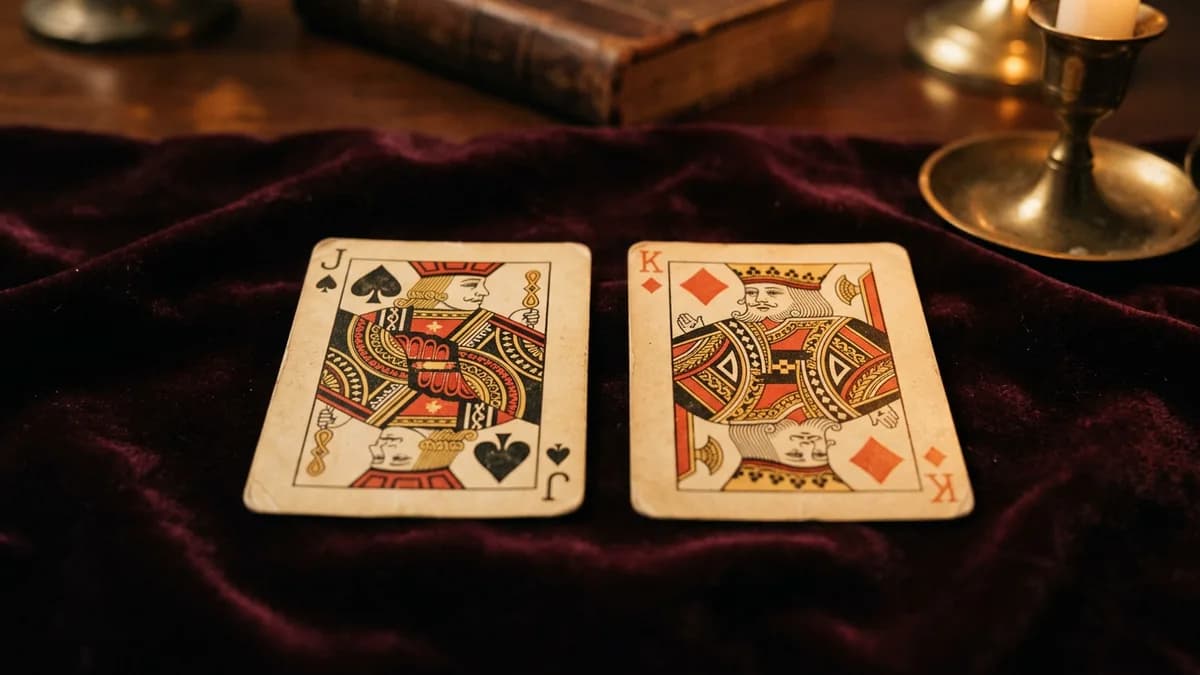
Kings are men of influence. This could be a father, husband, boss, or older brother. The King of Hearts is a loving man, often married or one who experiences strong feelings. The King of Diamonds is a young, single man or someone with whom you have financial dealings. The King of Clubs is a serious businessman, colleague, or someone who can be relied upon. The King of Spades is a strict man, often an institutional figure, a judge, a doctor, or someone who can create obstacles for you if they are hostile.
Queens: The Women in Your Life
Queens represent feminine energy. The Queen of Hearts is a friend, mother, or the querent herself if she is young. She is benevolent and emotional. The Queen of Diamonds is a young woman, often a friend or colleague, sometimes associated with gossip or news. The Queen of Clubs is a mature, practical woman, a businesswoman, or a mother-in-law. The Queen of Spades has a bad reputation in cartomancy – she is often read as a rival in love, a malicious woman, an intrigante, or a widow. Her appearance always requires increased attention.
Jacks: Youths, Children, and Thoughts
Jacks are the most multi-layered figures. They can represent young people (children, teenagers, young lovers), but are very often read as the "thoughts" or "concerns" of the corresponding King or Queen of the same suit. For example, the Jack of Hearts represents romantic stirrings and intentions. The Jack of Diamonds represents financial concerns or quick news. The Jack of Clubs represents work problems or efforts that need to be made. The Jack of Spades represents false hopes, minor worries, or ill intentions.
A Brief Overview of Numbers (from 6 to Ace)
The numbers in a 36-card deck indicate events, time, and circumstances surrounding people. Each number has a basic meaning that is colored by its suit. If you want to delve into the details of each individual card, consult our complete guide to The Meaning of the 36 Playing Cards.
Here is the basic logic of numbers in cartomancy:
| Number | Basic Meaning | Example by Suit |
|---|---|---|
| Six (6) | Roads, travel, movement. | 6 of Hearts = love journey; 6 of Clubs = business trip; 6 of Spades = late or unpleasant journey. |
| Seven (7) | Meetings, conversations, short communication. | 7 of Diamonds = business talk; 7 of Spades = argument, tears, unpleasant meeting. |
| Eight (8) | Serious conversations, discussions, company. | 8 of Hearts = heartfelt conversation; 8 of Clubs = business negotiations, work meeting. |
| Nine (9) | Love, changes, strong desires. | 9 of Hearts = mutual love; 9 of Spades = illness, serious grief, or loss. |
| Ten (10) | Interests, money, major events. | 10 of Diamonds = large sum of money; 10 of Clubs = professional success; 10 of Spades = failure of plans. |
| Ace (A) | Home, institution, important news, beginning. | Ace of Hearts = family home; Ace of Clubs = government building/job; Ace of Spades = blow, bad news (if reversed). |
Notice how Spades always turn the meaning of the number in a negative direction. The Nine is love and desire, but the Nine of Spades is illness and ruin. The Six is a journey, but the Six of Spades is a journey you'd better not take.
How to Read Cards Together: The Art of Combinations
If there is one secret that separates beginners from true masters, it is reading combinations. In cartomancy, one card is just a word. Two cards are a phrase. Three cards are a complete sentence. Never draw one card and draw general conclusions solely from it. The meaning of each card changes drastically depending on which card is to its left and right.
Let's take the Nine of Hearts (sincere love) as an example.
If it is accompanied by the Ten of Hearts (joy, wedding) and the King of Hearts, you are looking at a picture of perfect, shared love and likely a marriage proposal.
But what happens if the same Nine of Hearts is surrounded by the Queen of Spades (malicious woman/rival) and the Ten of Spades (failure, end)? Suddenly, the love is shattered by the interference of a third person, leading to separation and tears. The card of love is there, the feeling existed, but the adjacent cards show its end.
Another classic example is related to money. The Ten of Diamonds represents significant money. If it is accompanied by the Seven of Diamonds (contract, document) and the Ace of Clubs (government institution, bank), it signifies a successful loan application or the signing of a very lucrative official contract. But if the Ten of Diamonds is accompanied by the Jack of Spades (deception, false hopes), it is a clear warning: the money you are waiting for will not come, or you will be financially deceived.
Mastering this technique requires practice. Start drawing three cards each day and try to form a logical sentence from them. For more examples and detailed explanations, see our article on Playing Card Combinations - How to Read Them Together.
Basic Layouts for Beginners
Once you know the cards and understand how they connect, it's time to lay them out on the table. Layouts are called "spreads." There are hundreds of types of spreads – from those with 3 cards to complex gypsy spreads that use the entire 36-card deck at once. For beginners, it is essential to start with something simple so as not to get confused in the sea of information. Detailed instructions can be found in our material How to Read Fortune with Playing Cards - Step-by-Step Spreads.
3-Card Spread (Past, Present, Future)
This is the quickest and easiest way to get an answer to a specific question. Shuffle the deck, cut it, and draw three cards, laying them out from left to right. The left card shows the root of the problem (the past). The middle card shows the current situation (the present). The right card shows the most likely outcome (the future). Read them first individually according to their position, and then synthesize them into one cohesive story.
9-Card Square (The Little Table)
This spread provides a much more detailed picture and is a classic in cartomancy. Draw 9 cards and arrange them in three rows of three cards each (like a tic-tac-toe grid). The top row (cards 1, 2, 3) shows the querent's thoughts, plans, and what is "on their mind." The middle row (cards 4, 5, 6) shows the present, what is happening around them at the moment. The central card (number 5) is the core of the entire issue. The bottom row (cards 7, 8, 9) shows the future and the events that will knock on their doorstep. In addition to horizontal reading, you can also read the cards vertically (past, present, future) and diagonally, creating an extremely rich network of meanings.
Tarot, Lenormand, or Ordinary Cards?
Often, people who want to engage in divination wonder which system to choose. Each has its advantages.
Tarot is a deeply psychological system. It uses 78 cards with rich illustrations. Tarot will explain *why* you feel a certain way, what your spiritual lessons are, and what subconscious blocks you have. It is excellent for self-discovery.
Lenormand cards (36 cards) are very similar to ordinary playing cards (in fact, each Lenormand card has a corresponding card in a standard deck). They use clear symbols (Anchor, Tree, Fox) and are also very specific.
Ordinary playing cards, however, remain the most accessible, fastest, and often the most uncompromising system. They are not interested in your spiritual growth. They answer questions like "Will they return my loan?", "Is he cheating on me?", "Will I find a job?". If you are looking for the raw truth without detours, this is your tool. If you are undecided about which system is for you, read our comparison: Playing Cards vs. Tarot and Lenormand - Which System.
Practical Tips from Old Fortune-Tellers
Cartomancy has its unwritten rules, passed down from generation to generation. Adhering to them helps achieve more accurate results and protects the diviner from energetic exhaustion.
First, never read cards when you are highly emotional – angry, crying, or panicked. Cards are a mirror. If you are in chaos, they will reflect your chaos and show you not the truth, but your own fears. Calm down, drink a glass of water, and then pick up the deck.
Second, do not ask the same question multiple times a day just because you didn't like the first answer. The cards will "stop speaking" and start drawing nonsense. Accept the first answer, however difficult it may be.
Third, do not overdo it. Fortune-telling requires concentration. If you read for many people one after another, you will feel physical fatigue. Cleanse your deck energetically – some tap it lightly on the table, others leave it in moonlight.
If you don't have a deck at hand at the moment but have an urgent question, you can try our digital application for free playing card fortune-telling, which follows the same traditional meanings and logic of spreads.
Frequently Asked Questions
Can I use a deck that has been played with?
It is not recommended. Playing cards absorb the energy of gambling, deception, and the competitive spirit of the players. For accurate predictions, you need a clean, new deck that is used exclusively and solely for fortune-telling.
Should I pay attention to whether the cards fall upright or reversed?
For beginners, it is better to read cards only in the upright position to avoid confusion. In the traditional Bulgarian and Russian schools, however, the position of Spades is of great importance. For example, the Ace of Spades with the point up is good news or a letter, but with the point down it is a heavy blow, shock, or a serious problem.
How often can I read my cards?
Avoid looking every day for trivial matters. Cards are used for important questions and guidance. For the same problem, it is advisable to read no more often than once a month, unless the circumstances have changed drastically.
What should I do if the cards show me something very bad?
Remember the golden rule: cards show the most likely outcome based on the current situation. They are a warning, not a final judgment. If you see a cluster of Spades, consider what actions you can take today to avoid the problem tomorrow.
Can I read for myself?
Yes, you can, but it is much more difficult. When we read for ourselves, we are emotionally invested in the outcome and are often inclined to interpret the cards as we wish, rather than as they have actually fallen. A great deal of objectivity is required.
Why are 36 cards used, not the full 52-card deck?
The use of 36 cards is a deeply rooted European tradition. Removing the twos, threes, fours, and fives removes the "noise" of small, insignificant events. A 36-card deck is much more direct, faster, and focused on the important things in life.
Card readings are a tool for self-knowledge and reflection. The information in this article is for educational purposes and does not replace professional advice. For important decisions, consult a specialist.
Comments
Related Guides
Explore more guides in Guides

How to Read Playing Cards - Step-by-Step Guide
In brief: Traditional playing card readings use a 36-card deck (from Six to Ace in all four suits). A well-posed question is half the answer. Avoid yes/no questions

Meaning of the 36 Playing Cards
In brief: Traditional divination uses a 36-card deck (from 6 to Ace in all four suits). Each suit corresponds to a specific area of life: Hearts represent emotions…
Playing Card Combinations - How to Read Them Together
In short: A single card only gives the theme, but true divination happens when we read playing cards together. They form sentences. The method is simple: the first card…