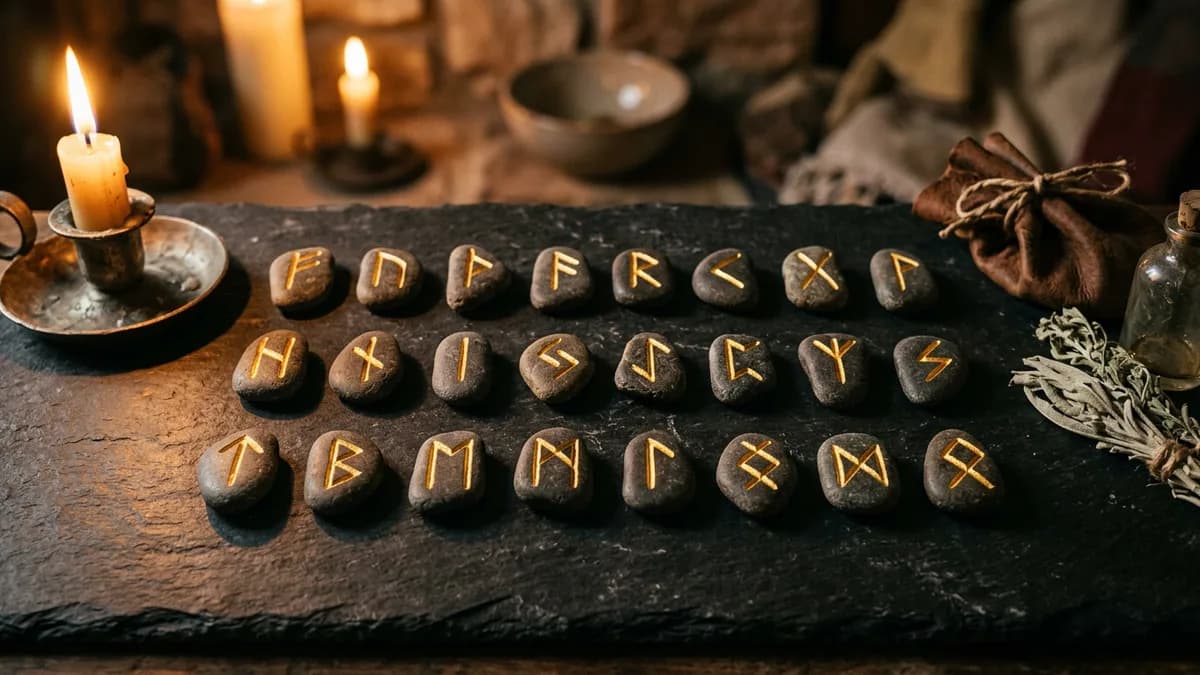
Meaning of the 24 Runes (Elder Futhark)
In brief:
- The Elder Futhark is an ancient system of 24 runes used for writing and divination, divided into three groups of eight runes called aettir.
- Each rune's meaning carries a specific energy related to human experience-from material survival to spiritual development and social connections.
- Asymmetrical runes change their meaning when they appear reversed (merkstave), indicating blockages or internal conflicts, while symmetrical runes retain their core character.
- Interpreting the 24 runes requires viewing them not as isolated symbols, but as a connected narrative reflecting the current processes in your life.
Fundamentals of the Elder Futhark and Rune Logic
The Elder Futhark is the oldest known runic alphabet, consisting of exactly 24 runes. It is not merely a list of symbols but a comprehensive conceptual framework describing the cycle of life, natural laws, and human psychology. Each rune represents a specific force or state. When we consider the 24 runes as a divination system, we are essentially using these ancient archetypes to analyze our contemporary problems, decisions, and relationships.
To fully understand how this system works, it's helpful to familiarize yourself with our Runes – A Complete Beginner's Guide to Divination. There, you will discover the basic principles of working with these symbols. The key to accurate interpretation is to clear your mind of mystical stereotypes and view the runes as a mirror of reality. They do not preordain a fatal future but indicate which energies are currently active and where your current course of action is most likely to lead you.
The Three Aetts and the Structure of the Futhark
The 24 runes are not arranged randomly. They are divided into three groups of eight runes. These groups are called "aettir." Each aett is associated with a specific Norse deity and represents a different stage of human and world development. For a more in-depth analysis of this structure, you can read the article on The Three Aetts of the Runes (Aettir) and Their Meanings.
The first aett (Freyr's aett) deals with creation, the material world, basic needs, and primal forces. The second aett (Heimdall's aett) describes the objective forces of nature, challenges, fate, and psychological resilience. The third aett (Tyr's aett) focuses on human society, law, spiritual growth, and the completion of cycles. Below, we will examine the meaning of each rune in detail.
Freyr's Aett: The Material World and Beginnings
This aett begins with the concept of wealth and concludes with the joy of achievement. Here, the runes describe the basic conditions for life, physical strength, communication, and the first steps on a chosen path.
Fehu (Fehu)
Fehu is the rune of movable property, material resources, and the life force that circulates in our lives. It doesn't just mean money in the bank, but rather our ability to generate value, manage our resources wisely, and create stability through active actions. The appearance of Fehu in an upright position is a strong indicator of a successful outcome from labor, financial reward, or a surge of energy that needs to be directed constructively to avoid stagnation.
Reversed meaning: Indicates blockages in material flow, possible financial losses, dissatisfaction with achievements, or a warning that you are focusing too much on possessions at the expense of your inner balance.
Uruz (Uruz)
Uruz symbolizes primal, wild power, physical health, and raw potential yet to be shaped. It is the energy of growth, endurance, and the courage to face difficulties with unwavering will. In daily life, this rune indicates that you have the necessary vitality and courage to overcome obstacles, as long as you channel this powerful energy instead of allowing it to become destructive.
Reversed meaning: Indicates a decline in vitality, health problems, lack of motivation, or a situation where brute force is used inappropriately, leading to conflict.
Thurisaz (Thurisaz)
Thurisaz is the rune of conflict, reactive force, and protective boundaries, resembling a thorn that guards a flower but can also wound. It represents moments of confrontation where we must defend our positions, as well as the need for careful consideration before action to avoid causing unwanted chaos. The upright position often signifies that you must confront a problem directly, using your will as a shield and weapon, but with a clear assessment of the consequences.
Reversed meaning: Warns of self-sabotage, vulnerability, hasty reactions that worsen the situation, or persistent adherence to toxic behavioral patterns.
Ansuz (Ansuz)
Ansuz is the rune of communication, intellect, inspiration, and the transmission of knowledge. It is associated with the power of the spoken word, advice from authoritative figures, and moments of sudden insight that clarify complex situations. When upright, Ansuz advises you to pay attention to your words, listen carefully to what others are saying, and seek solutions through dialogue, learning, and logical analysis.
Reversed meaning: Signals misunderstandings, manipulation, bad advice, lack of clarity in communication, or a refusal to listen to the voice of reason.
Raidho (Raido)
Raidho symbolizes journey-both physical movement from one place to another and the inner process of personal development and movement towards a goal. It carries the energy of rhythm, correct direction, and the ability to take control of your own life by making conscious decisions. The appearance of Raidho confirms that you are on the right path and that now is the time for action, as circumstances support your progress.
Reversed meaning: Indicates delays, canceled plans, a feeling of stagnation, wrong direction, or resistance to the natural course of events.
Kenaz (Kenaz)
Kenaz is the torch in the darkness, the rune of clarity, knowledge, and technical skill. It represents the illumination of a problem, the discovery of truth, and the creative spark that allows us to transform raw materials into something useful. Practically, Kenaz indicates that you have the necessary knowledge and skills to handle the task, or that you will soon receive an insight that will dispel confusion.
Reversed meaning: Signifies loss of inspiration, creative block, concealment of truth, misunderstanding of the situation, or the end of a phase that requires rethinking.
Gebo (Gebo)
Gebo is the rune of the gift, exchange, partnership, and the balance between giving and receiving. It teaches us that every relationship-whether personal, business, or spiritual-requires balance, mutual respect, and honesty to be sustainable. The appearance of this rune is an excellent sign for making agreements, successful alliances, and harmonious relationships based on mutual benefit and support.
Reversed meaning: Gebo is a symmetrical rune and has no reversed meaning. Its message is always related to the theme of exchange, although in a negative context from other runes, it may suggest an unequal partnership.
Wunjo (Wunjo)
Wunjo is the rune of joy, harmony, emotional satisfaction, and the sense of belonging to a community. It marks the successful completion of a difficult period, the achievement of inner peace, and the ability to enjoy the fruits of one's labor in the company of loved ones. Upright Wunjo is one of the most positive signs in the Futhark, promising well-being, teamwork, and genuine happiness.
Reversed meaning: Indicates sadness, alienation, disharmony in relationships, disappointment with achievements, or a period of emotional instability.
Heimdall's Aett: Challenges and Objective Forces
The second aett takes us out of our comfort zone. Here, we encounter forces greater than ourselves-time, fate, the elements of nature. These runes teach us patience, resilience, and acceptance of what we cannot change.
Hagalaz (Hagalaz)
Hagalaz is the rune of objective reality, radical change, and the destruction of old structures, much like a summer hail that sweeps away crops but nourishes the earth. It signifies events beyond our control that clear the way for something new, requiring us to accept the situation without resistance and build stronger foundations. This crisis is not a punishment but a necessary course correction that removes what no longer serves us.
Reversed meaning: Hagalaz is a symmetrical rune. Its action is always transformative, regardless of orientation, with the intensity of "destruction" depending on the neighboring runes.
Nauthiz (Nauthiz)
Nauthiz symbolizes need, constraint, friction, and the necessity of patience in difficult times. It teaches us to recognize the difference between what we want and what we truly need, forcing us to develop discipline and inner strength by overcoming deprivation. The appearance of Nauthiz is advice not to force events, to accept delays, and to work diligently with the resources currently available.
Reversed meaning: Although often read as symmetrical, when interpreted reversed, Nauthiz indicates unnecessary suffering, self-imposed limitations, depression, or persistence in a situation that is doomed to fail.
Isa (Isa)
Isa is the rune of ice, stagnation, concentration, and the preservation of the current state. It represents a pause period where external movement has stopped, but important processes of crystallization and inner awareness are occurring beneath the surface. When Isa appears, the best course of action is inaction-wait, conserve your energy, cool your emotions, and do not try to break through the wall head-on.
Reversed meaning: Isa is a perfectly symmetrical vertical line and has no reversed meaning. It always carries the energy of stopping and focus.
Jera (Jera)
Jera symbolizes the cyclical nature of time, patience, and the harvest that comes after a long period of hard work and care. This rune teaches us that results do not come instantly, but when we have sown the right seeds and put in the necessary effort, the reward is certain and deserved. Jera carries a message of justice, natural balance, and the successful completion of a cycle that opens the door to the next.
Reversed meaning: Jera is a symmetrical rune. Its message of time and results remains constant, although in a negative context it may mean you are reaping the consequences of bad decisions.
Eihwaz (Eihwaz)
Eihwaz is the rune of the yew tree, the axis of the worlds (Yggdrasil), and deep transformation through endurance. It represents the process of overcoming difficulties that forge our character, connecting life and death, beginning and end in a continuous line of development. The appearance of Eihwaz indicates that you have the strength to withstand trials and that the current challenges are necessary for your spiritual and life growth.
Reversed meaning: Eihwaz is a symmetrical rune. Its energy is always related to resilience and transformation.
Perthro (Perthro)
Perthro is the rune of mystery, hidden factors, fate, and potential yet to be revealed, symbolized by a cup for casting dice. It indicates that there are elements in the situation that are beyond your knowledge, or that a secret is about to be revealed that will change the rules of the game. Perthro reminds us that while we don't control which dice we are dealt, we choose how to play our hand.
Reversed meaning: Signifies unpleasant surprises, revelation of uncomfortable secrets, a feeling of loss of control over fate, or stagnation due to fear of the unknown.
Algiz (Algiz)
Algiz is the rune of protection, the instinct for self-preservation, and the connection to our higher self or spiritual guides. It resembles the spread antlers of a moose or a person with arms raised to the sky, symbolizing our ability to sense dangers in advance and set healthy boundaries. Upright Algiz assures you that you are protected, as long as you remain vigilant, trust your intuition, and do not take unnecessary risks.
Reversed meaning: Warns of hidden danger, weakened protection, naivety, bad advice, or a situation where you have allowed someone to violate your personal boundaries.
Sowilo (Sowilo)
Sowilo is the sun, life force, victory, and absolute clarity that dispels all darkness and doubt. This rune carries powerful positive energy, promising success, good health, and the achievement of goals through confidence and correctly directed will. Sowilo encourages you to shine, believe in yourself, and use your full potential, as the moment is extremely favorable for self-expression.
Reversed meaning: Sowilo is a symmetrical rune. It has no reversed meaning, but in the context of many negative runes, it may warn of burnout or excessive ego.
Tyr's Aett: Society, Spirit, and Completion
The third aett focuses on the human being as a social and spiritual entity. Here, we find themes of justice, family, partnerships, intuition, and ultimately, the legacy we leave behind.
Tiwaz (Tiwaz)
Tiwaz is the rune of justice, law, logic, and self-sacrifice for a higher purpose, bearing the name of the warrior god Tyr. It represents the ability to act with principle, take responsibility, and fight for what is right, even if it requires sacrifice. In practical divination, upright Tiwaz indicates success in legal disputes, victory through fair play, and the need for a rational, rather than emotional, approach to the problem.
Reversed meaning: Indicates injustice, lack of motivation, refusal to take responsibility, loss of a competition, or a situation where principles are compromised due to fear or laziness.
Berkana (Berkana)
Berkana is the rune of the birch tree, feminine energy, motherhood, nurturing, and gradual, organic growth. It symbolizes the creation of a safe environment where new ideas, projects, or relationships can develop naturally and without tension. The appearance of Berkana is a sign of healing, new beginnings, fertility, and the need to approach the situation with patience, gentleness, and constant care.
Reversed meaning: Indicates family problems, slow growth, lack of care, conflicts with loved ones, or projects that cannot develop due to a poor environment.
Ehwaz (Ehwaz)
Ehwaz is the rune of the horse, loyalty, teamwork, and joint progress towards a common goal. It describes an ideal partnership where two different forces work in perfect synchrony to achieve what neither could alone. Upright Ehwaz is an excellent sign for marriage, stable business partnerships, smooth career progression, and trust between people who are on the same path.
Reversed meaning: Signals disharmony in a partnership, lack of trust, divergence of goals, delayed progress, or the feeling that you are "pulling the cart" all by yourself.
Mannaz (Mannaz)
Mannaz symbolizes humanity itself, social structures, intellect, and our place in society. It reminds us that although we are individuals, we are part of a larger network of relationships, and our actions impact the collective. In divination, Mannaz often indicates the need for objective self-analysis, seeking support from the community, or advises approaching the problem with humanity, tolerance, and reason.
Reversed meaning: Signifies social isolation, conflict with society, egocentrism, lack of support from others, or internal confusion about your own identity.
Laguz (Laguz)
Laguz is the rune of water, the subconscious, intuition, and the continuous flow of life that tolerates no barriers. It teaches us to trust our inner voice, sense emotional currents, and adapt to changes rather than fighting them. When upright, Laguz advises you to let go of control, go with the flow, and allow your intuition to guide you through unclear situations.
Reversed meaning: Indicates emotional imbalance, blocked intuition, fear of the unknown, bad premonitions, or a situation where you are trying to swim against a strong current.
Inguz (Inguz)
Inguz is the rune of the seed, potential, inner growth, and preparation for a new life stage. It represents a period of isolation or concentration where you gather strength and shape your plans before revealing them to the world. The appearance of Inguz is a strongly positive sign for the successful completion of an old project and the gestation (literal or metaphorical) of new ideas that will soon blossom.
Reversed meaning: Inguz is a symmetrical rune. Its meaning is always related to potential and inner growth.
Dagaz (Dagaz)
Dagaz is the rune of dawn, awakening, radical transformation, and paradigm shift. It marks the moment when night turns into day, bringing sudden insight, hope, and a complete reversal of the situation for the better. Dagaz indicates that you are on the verge of a major breakthrough, that the difficult period is ending, and that you should be ready to welcome the new light without fear of the past.
Reversed meaning: Dagaz is a symmetrical rune. It has no reversed meaning and always carries the energy of a major turning point and awakening.
Othala (Othala)
Othala is the rune of inheritance, ancestral home, traditions, and everything that is deeply rooted and gives us a sense of belonging. It symbolizes real estate, spiritual experience passed down through generations, and the security that comes from strong foundations. Upright Othala indicates issues related to family, home, inheritance, or the need to rely on established principles and the experience of your ancestors.
Reversed meaning: Warns of family conflicts, property issues, alienation from roots, adherence to outdated dogmas, or the need to break free from toxic ancestral patterns.
Practical Tips for Rune Interpretation
Knowing the individual meaning of the 24 runes is only the first step to mastering the Elder Futhark. The true art lies in the ability to read the runes together, like a sentence. When you perform a divination, the meanings intertwine and change depending on the context and neighboring symbols. To understand how to practically structure such a reading, we recommend the guide How to Divinate with Runes – Step-by-Step Layouts.
For example, if you draw Fehu (wealth) next to Isa (ice), it doesn't just mean "money" and "cold." It reads as "frozen resources"-perhaps a delayed payment or capital that cannot currently be used. If you combine Raidho (path) with reversed Algiz (lack of protection), the message is clear: "The journey or endeavor carries risks; be extremely careful."
Many beginners are intimidated by reversed runes. It's important to remember that they are not a curse. They simply indicate where energy is blocked or where inner work is required. If you want to delve deeper into this topic, the article on Reversed Runes (Merkstave) – Meanings and Interpretation will provide the necessary perspective.
If you're wondering whether runes are the right tool for you compared to other divination systems, you can explore our analysis Runes vs. Tarot and Lenormand – Which System to Choose. And if you're ready to put your learning into practice, you can perform a free rune casting directly on our website.
Frequently Asked Questions
What does it mean if only symmetrical runes appear in my spread?
Symmetrical runes (like Isa, Jera, Sowilo, Dagaz) carry energies that are more objective and inevitable. If you draw predominantly such runes, it usually means the situation is unfolding according to its own laws, and your personal control over it is currently limited. The message is to adapt to the circumstances rather than trying to force them to change.
Can I divine with just one rune per day?
Yes, drawing a "rune of the day" is one of the best practices for beginners. It helps you learn the meaning of each of the 24 runes through personal experience. Draw it in the morning, write it down, and in the evening, analyze how its energy manifested in the events of your day.
Why do some runes seem frightening (like Hagalaz or reversed Thurisaz)?
Runes reflect real life, and life includes storms, conflicts, and losses. Hagalaz, for example, represents destruction, but it is necessary to clear the way for the new. Frightening runes are not judgments but warnings and descriptions of difficult processes that we must go through to grow.
How do you determine if a rune is reversed if it lands on its side during a casting?
If you cast runes on cloth (traditional method) and one lands horizontally, you typically look at which way its tip or top points relative to you. If the top points to the right (reading direction), it's considered upright. If it points to the left-reversed. If you are a beginner, it's easier to draw runes from a pouch and place them directly upright or reversed.
Does the material the runes are made from matter?
Traditionally, runes are made from natural materials-wood, stone, bone, or clay-as they conduct natural energy best. However, the material does not change the meaning of the runes themselves. The most important thing is that you feel a connection with your set. Even paper runes will work accurately if you approach divination with focus and respect.
Do I need to learn the names of the deities to read runes?
It's not mandatory, but it is very helpful. Understanding the mythology (e.g., Tiwaz's connection to the god Tyr and his sacrifice) provides a much deeper context for the rune's meaning and helps you interpret them more richly and nuancedly in real situations.
Rune divination is a tool for self-knowledge and reflection. The information in this article is for educational purposes and does not replace professional medical, psychological, or financial advice. For important life decisions, consult a specialist.
Comments
Related Guides
Explore more guides in Guides
How to Read Runes - Step-by-Step Guide
In short: Successful rune readings begin with a well-formulated question – open-ended questions focused on action and self-reflection yield the most accurate answers…
Reversed Runes (Merkstave) - Meanings and Interpretation
In short: Reversed runes (merkstave) are not a curse or bad omen; they indicate blocked energy, delays, or an internal process requiring attention. Of the 24 runes in…
Runes: A Complete Beginner's Guide to Divination
In short: Runes are an ancient Germanic alphabet used for writing, divination, and symbolic magic. The most popular system is the Elder Futhark, consisting of 24 symbols…