
The Three Aetts of the Runes and Their Meanings
In short:
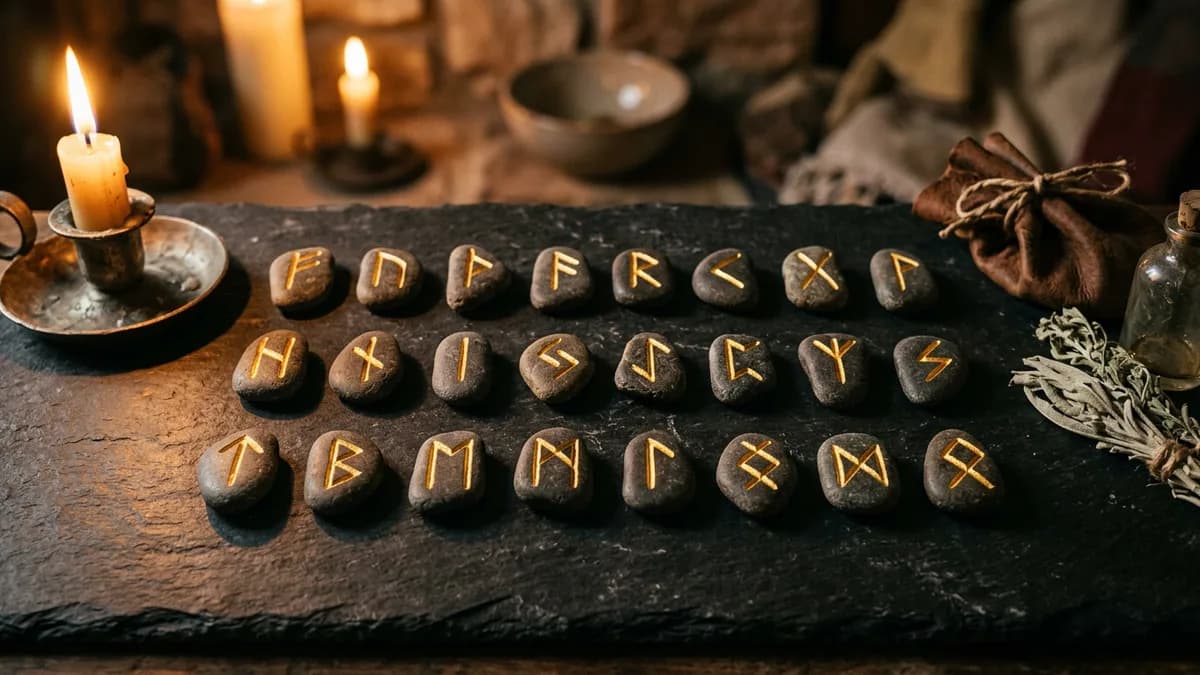
- The Elder Futhark consists of 24 runes, divided into three groups of eight, called aettir.
- The first aett (of Freyr) covers the runes from Fehu to Wunjo. Its theme is the material world, creation, basic needs, and building a stable foundation for life.
- The second aett (of Heimdall/Hagal) includes the runes from Hagalaz to Sowilo. It focuses on the forces of nature, crisis, transformation, and trials that temper character.
- The third aett (of Tyr) contains the runes from Tiwaz to Dagaz. The unifying theme is spirituality, society, laws, human relationships, and leaving a legacy.
- Knowing these rune groups provides an additional layer of information during divination – the predominant aett in a spread indicates the sphere of life where the root of the situation lies.
What are Aettir in the Elder Futhark
When you begin to study the Elder Futhark, you quickly notice that the 24 symbols are not just an arbitrary alphabet. They follow a strict structure and logical sequence. This system is divided into three equal parts of eight runes each. Each of these groups is called an "aett" (plural: aettir), which in Old Norse means "clan" or "family."
The concept of rune aettir is fundamental to understanding the overall philosophy of the Norse tradition. Runes do not exist in a vacuum. Each one arises from the previous and prepares the ground for the next. The division into three aettir creates a clear narrative path – from primal creation and the satisfaction of material needs, through the confrontation with harsh reality and the elements, to the building of society, laws, and spiritual awareness.
To interpret the messages accurately, it is necessary to know not only the individual meaning of the 24 runes (Elder Futhark), but also the context of the family to which they belong. The three aettir - Freyr, Heimdall, Tyr runes - function as a macro-framework. When you draw a rune, its meaning is always colored by the general theme of its aett.
The First Aett - The Aett of Freyr (Creation and Material Foundation)
The first aett bears the name of the god Freyr (and his sister Freyja) – deities of the Vanir, associated with fertility, agriculture, wealth, and life force. This aett encompasses the first eight runes: Fehu, Uruz, Thurisaz, Ansuz, Raidho, Kenaz, Gebo, and Wunjo.
The theme here is physical existence. This is the phase of establishment. For the ancient Norse, survival depended on livestock, physical strength, the ability to defend themselves, communication within the tribe, and the creation of alliances. In a modern context, the Aett of Freyr relates to your resources, health, finances, career start, and basic security.
The Path of the Runes in the Aett of Freyr
The sequence of these eight runes describes the process of building a stable life from scratch:
- Fehu (Wealth/Cattle): Everything begins with primal energy and resources. Fehu is the spark of creation, material potential, and what you have to start with.
- Uruz (Wild Ox/Strength): Resources alone are not enough. Raw, untamed strength and endurance are needed to move them. Uruz provides the vitality and will to form.
- Thurisaz (Thorn/Giant): When strength is set in motion, it encounters resistance. Thurisaz is conflict, defense, and clearing the path. It is the aggressive energy needed to protect what you are creating.
- Ansuz (God/Inspiration): After brute force comes reason. Ansuz brings communication, advice, wisdom, and intellectual planning. Here, one realizes the need for knowledge to manage their resources.
- Raidho (Chariot/Journey): With resources, strength, defense, and a plan, you begin to move. Raidho is controlled action, the journey (physical or metaphorical), and taking responsibility for direction.
- Kenaz (Torch/Enlightenment): Along the way, you gain skills and clarity. Kenaz is the light of knowledge, craftsmanship, and the ability to shape matter according to your will.
- Gebo (Gift/Partnership): Once you have built yourself up, you begin to interact with others. Gebo is exchange, contracts, partnerships, and the balance between giving and receiving.
- Wunjo (Joy/Harmony): The aett concludes with Wunjo – the satisfaction of a job well done. This is a moment of cohesion, success, and harmony within the group after the efforts made.
When considering questions about a new job, buying a home, or starting a business in a complete beginner's guide to rune casting, the runes from this aett provide the most direct and clear answers. They tell you: "Focus on the foundation."
The Second Aett - The Aett of Heimdall (Forces of Nature and Transformation)
After achieving the comfort and joy of Wunjo, one can become complacent. This is when the second aett intervenes. Called the Aett of Heimdall (the guardian of the gods) or the Aett of Hagal (after the first rune in the group), it encompasses the runes from Hagalaz to Sowilo: Hagalaz, Nauthiz, Isa, Jera, Eihwaz, Perthro, Algiz, and Sowilo.
This aett is a drastic change in tone. Here, the theme is the confrontation with forces beyond our control. These are the objective conditions of the environment – winter, storms, limitations, fate, and time. The Aett of Heimdall teaches us humility, endurance, and adaptation. This is the phase of crisis that leads to deep inner transformation. In real life, these runes appear when we are going through difficulties, delays, or periods of forced change.
The Path of the Runes in the Aett of Heimdall
This group describes the process of surviving harsh conditions and drawing strength from the trials themselves:
- Hagalaz (Hail): The aett begins with a sudden destruction of the status quo. Hagalaz is the sudden crisis, the hail that destroys the harvest, but after it melts, it waters the earth. It clears illusions.
- Nauthiz (Need/Resistance): After the crisis comes deprivation. Nauthiz is friction, limitation, and the realization of what you truly need to survive versus what you simply want.
- Isa (Ice/Stasis): The situation freezes. Isa is the cessation of all movement. It is a time for waiting, conserving energy, and inner concentration while external conditions are unfavorable.
- Jera (Year/Harvest): The ice melts. Jera is the turning point – the realization of cycles. The efforts made during hardships slowly begin to yield results according to the natural course of time.
- Eihwaz (Yew/Axis of the World): Having overcome difficulties, you build a strong backbone. Eihwaz is the tree of life, connecting the worlds. It symbolizes endurance, reliability, and the ability to stand firm in the storm.
- Perthro (Mystery/Fate): With new stability comes an understanding of hidden forces. Perthro is mystery, the casting of dice, accepting what is written (Wyrd), and realizing your own responsibility in the game of life.
- Algiz (Elk/Protection): Understanding your fate, you learn to protect yourself. Algiz is instinct, spiritual protection, and connection to higher guidance that shields you from danger.
- Sowilo (Sun/Success): The aett concludes with triumph. Sowilo is the life-giving sun that finally banishes ice and darkness. It brings vitality, clarity, and victory after a long and arduous period of trials.
When doing a free rune reading and drawing predominantly symbols from this aett, the message is clear: the situation requires patience. You cannot force your will with strength (as in the first aett). You must adapt to external circumstances and wait for the right moment.
The Third Aett - The Aett of Tyr (Spirituality, Society, and Completion)
The third and final aett bears the name of the god Tyr – the god of law, justice, honor, and self-sacrifice for the common good. This group includes the runes from Tiwaz to Dagaz: Tiwaz, Berkano, Ehwaz, Mannaz, Laguz, Ingwaz, Othala, and Dagaz.
After securing their material base (The Aett of Freyr) and being tempered in life's storms (The Aett of Heimdall), one is ready to take their place in society and the cosmos. The theme here is the human community, the laws that govern us, spiritual growth, and what we leave behind. The Aett of Tyr shifts the focus from individual survival to collective well-being and higher consciousness.
The Path of the Runes in the Aett of Tyr
This group describes the integration of the individual into the larger picture and the attainment of spiritual enlightenment:
- Tiwaz (God Tyr/Justice): The aett begins with order and discipline. Tiwaz is the moral compass, the willingness to sacrifice personal interest for the right cause, and clear, purposeful will.
- Berkano (Birch/Rebirth): After establishing order, growth comes. Berkano is maternal energy, care, healing, and creating a safe environment where new ideas (or new life) can develop.
- Ehwaz (Horse/Cooperation): Growth requires teamwork. Ehwaz is loyalty, synchronization between two beings (like a rider and horse), and joint progress towards a common goal.
- Mannaz (Man/Humanity): Here, the focus expands to the entire society. Mannaz represents human nature, intellect, social connections, and the realization that we are all connected in the web of life.
- Laguz (Water/Intuition): Beyond the rational mind lies the subconscious. Laguz is the flow of emotions, intuition, dreams, and the deep psychological processes that guide human behavior.
- Ingwaz (God Ing/Seed): It is time to gather energy. Ingwaz is potential, the pregnancy of an idea, inner focus before the big leap. It is a moment of isolation for preparation for transformation.
- Othala (Inheritance/Home): The result of the entire life path. Othala is what we inherit from our ancestors, and what we will leave to future generations. It is tradition, home, and spiritual belonging.
- Dagaz (Day/Awakening): The Futhark concludes with complete transformation. Dagaz is the dawn, enlightenment, a radical paradigm shift, and the merging of opposites. The end of one cycle and the beginning of a new one.
In divination, runes from this aett often point to questions related to morality, long-term plans, family traditions, or the need to seek help from others. They require maturity and responsibility.
How to Use Aettir in Divination
Knowing the aettir is not just a theoretical concept; it is an extremely practical tool when applying your knowledge of how to cast runes - step-by-step spreads. The aettir give you context that can completely change the nuance of a reading.
Determining the Predominant Energy
When you perform a spread of three or more runes, the first thing you should look at is which groups they belong to. This immediately tells you "where" the problem lies:
- Predominance of runes from the Aett of Freyr: The situation is practical. The problem is rooted in resources, money, physical energy, or a lack of a clear action plan. The solution requires work and management of material assets.
- Predominance of runes from the Aett of Heimdall: The situation is beyond your direct control. You are facing external factors, delays, or karmic lessons. The solution requires patience, adaptation, and inner resilience. Do not force things.
- Predominance of runes from the Aett of Tyr: The situation is social, ethical, or spiritual. The problem lies in relationships with people, adherence to rules, or a lack of long-term vision. The solution requires honesty, cooperation, and taking responsibility.
Context for Reversed Runes
The aettir are extremely helpful in interpreting blockages. If you draw a reversed rune, its aett suggests the nature of the resistance. You can read more about this in the article on reversed runes (merkstave) - meanings and interpretation. For example, a reversed Uruz (Aett of Freyr) indicates physical exhaustion or lack of motivation. A reversed Tiwaz (Aett of Tyr) indicates injustice, lack of morals, or failure in teamwork. The root of the problem is different – in the first case, it is biological/energetic; in the second, it is social/ethical.
Practical Example
Imagine you ask: "How should I approach the current conflict at work?" and you draw three runes: Thurisaz, Isa, Ehwaz.
The analysis through the lens of the aettir looks like this:
- Thurisaz (Aett of Freyr): Initially, the conflict was direct, aggressive, related to territory or resources. There was a need for defense.
- Isa (Aett of Heimdall): Currently, the situation is frozen. External factors have halted progress. There is no point in continuing to attack (as with Thurisaz), because the ice will not yield to brute force.
- Ehwaz (Aett of Tyr): The resolution lies in the third aett – in the social sphere. Ehwaz requires partnership, finding a common rhythm, and cooperation. You need to move from a survival and defense mode to a teamwork mode.
This structural approach is one of the reasons many practitioners prefer runes over other systems. If you are unsure which divination system is for you, you can consider the comparison Runes vs. Tarot and Lenormand - Which System to Choose.
Frequently Asked Questions
Why are the runes divided into exactly three groups of eight?
The number eight (and its multiple 24) has deep symbolic meaning in Germanic and Norse cosmology. There are eight directions of the world in the Norse compass, and eight legs on Odin's horse (Sleipnir). The division into three reflects the three worlds (Asgard, Midgard, Helheim) or the three phases of being – creation, maintenance/destruction, and rebirth.
Does the aett of the first rune in a spread matter?
Yes. The first rune often sets the tone for the entire reading. If it is from the Aett of Freyr, the question is deeply connected to practical and material needs. If it is from the Aett of Heimdall, it indicates that the situation is caused by external events, not by your actions.
What does it mean if runes from a certain aett are missing from my reading?
The absence of a particular aett is as telling as its presence. If you draw five runes and none are from the Aett of Tyr, it may mean that the situation lacks social support, legality, or long-term vision – everything boils down to raw survival and immediate reaction.
Why is the second aett sometimes called Hagal's Aett and other times Heimdall's Aett?
In historical sources, the aettir are often named after the first rune in them (Freyr for Fehu, Hagal for Hagalaz, Tyr for Tiwaz). In later esoteric traditions, the second aett began to be associated with the god Heimdall – the guardian of the Bifrost bridge, as the runes in this aett are often linked to protection, boundaries, and transitions between states.
Can I cast runes using only one aett?
Technically, it is possible, but not recommended. Using only eight runes drastically limits the spectrum of answers. The Elder Futhark is a complete system, describing the full cycle of human experience. Drawing one aett is like removing an entire octave from a piano.
How do the aettir help in remembering the runes?
Learning 24 abstract symbols at once is difficult. Grouping them into three stories of eight runes makes the process much more intuitive. Instead of rote memorization, you follow a logical narrative: from acquiring the cow (Fehu) to achieving spiritual enlightenment (Dagaz).
Rune readings are a tool for self-knowledge and reflection. The information in this article is for educational purposes and does not replace professional medical, psychological, or financial advice. For important life decisions, consult a specialist.
Comments
Related Guides
Explore more guides in Guides
Meaning of the 24 Runes (Elder Futhark)
In brief: The Elder Futhark is an ancient system of 24 runes used for writing and divination, divided into three groups of eight runes called aettir. Each rune meaning…
Reversed Runes (Merkstave) - Meanings and Interpretation
In short: Reversed runes (merkstave) are not a curse or bad omen; they indicate blocked energy, delays, or an internal process requiring attention. Of the 24 runes in…
How to Read Runes - Step-by-Step Guide
In short: Successful rune readings begin with a well-formulated question – open-ended questions focused on action and self-reflection yield the most accurate answers…